
This blog post explores the early challenges faced by Christianity in the second century, including political, religious, and philosophical threats. It highlights the resilience of early Christians, their responses to persecution, and the emergence of apologists who defended the faith.
The early history of the Christian church is marked by significant challenges and threats, particularly during the second century. This period, spanning from 100 AD to 200 AD, was characterized by political, religious, and philosophical opposition to the burgeoning Christian faith. This blog post delves into these challenges and the responses of early Christians, including the emergence of apologists who defended their beliefs.
Following the fall of Jerusalem in 70 AD, the Roman Empire underwent significant changes. After the death of Emperor Nero in 69 AD, Vespasian became emperor and ruled until 79 AD. During this time, the Jewish rebellion against Roman rule intensified, leading to the destruction of Jerusalem. Vespasian's general, Titus, was tasked with quelling this rebellion, which he did through a prolonged siege that ultimately resulted in the city's destruction.
As Christianity began to spread from Jerusalem to other regions, including Antioch and Ephesus, it faced numerous challenges that would shape its development.
Early Christians encountered three primary threats during the second century:
The political landscape of the Roman Empire was fraught with hostility towards Christians. From Nero to Domitian, several emperors enacted policies that led to widespread persecution. Notably, Nero blamed Christians for the Great Fire of Rome in 64 AD, leading to brutal executions. Roman historian Tacitus documented these events, describing how Christians were subjected to horrific punishments, including being burned alive or fed to wild beasts.
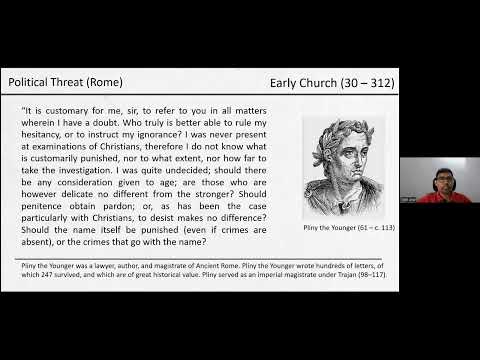
The persecution continued under subsequent emperors, including Trajan, who expressed uncertainty about how to handle Christians in his correspondence with Pliny the Younger. Pliny's letters reveal the complexities of dealing with Christians, who were often accused of atheism for refusing to worship Roman gods. This misunderstanding contributed to the societal perception of Christians as a dangerous sect.
In addition to political challenges, early Christians faced religious opposition from Jewish groups. One significant movement was the Elogai, which rejected the concept of the Logos as presented in the Gospel of John. This group, along with the Ebionites, denied the divinity of Jesus, viewing him merely as a gifted human being rather than the Son of God. Their beliefs posed a direct challenge to the foundational tenets of Christianity, leading to further divisions within the early church.
The philosophical landscape of the time also presented challenges to early Christians. Pagan philosophies often clashed with Christian beliefs, leading to accusations of cannibalism and incest due to misunderstandings of Christian practices, such as the Eucharist and the communal nature of early Christian gatherings. These misconceptions fueled public animosity towards Christians, further complicating their efforts to spread the faith.
In response to these threats, early Christians developed a group of defenders known as apologists. These individuals sought to articulate and defend the Christian faith against misconceptions and accusations. They wrote extensively, addressing the political, religious, and philosophical challenges posed by their opponents. Notable apologists included Justin Martyr and Tertullian, who argued for the rationality of Christianity and its moral superiority.
The second century was a tumultuous time for early Christianity, marked by significant challenges from various fronts. Despite the political, religious, and philosophical threats, early Christians demonstrated remarkable resilience and commitment to their faith. Their willingness to suffer persecution and defend their beliefs laid the groundwork for the eventual acceptance and spread of Christianity throughout the Roman Empire. As we continue to explore this period, it is essential to recognize the courage and determination of those early believers who shaped the future of the church.



















