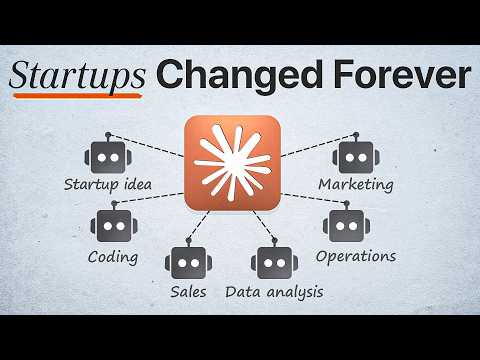
AI technology has revolutionized startup dynamics, enabling solo founders to build billion-dollar companies without large teams. Innovations like Claude Code allow non-technical founders to manage coding and operations independently. Companies like Headshot Pro and Gamma exemplify this shift, achieving massive revenue with minimal staff. While AI handles execution, strategic decisions remain human-led, marking a new era in entrepreneurship.
Sam Altman, a prominent figure in the tech world, once engaged in a group chat with his CEO friends, betting on when the first one-person billion-dollar company would emerge. Initially, he believed such a feat was impossible without artificial intelligence (AI). However, as of 2024, this prediction is rapidly becoming reality.
In the past, building a successful company required assembling a sizable team. For example, in 2012, Facebook acquired Instagram for one billion dollars when Instagram had only 13 employees. This was seen as an anomaly, a rare case where timing and virality allowed a small team to succeed. Similarly, Facebook's acquisition of WhatsApp in 2014 for 19 billion dollars involved a company with 55 employees serving 450 million users.
Traditionally, startups needed dedicated personnel for sales, support, engineering, marketing, operations, and finance. Each function required hiring new people, which increased costs, equity dilution, and management complexity. Execution, rather than ideas, was the main constraint.
AI has not only accelerated these functions but has started replacing the need for dedicated personnel altogether. This shift means that the old model of requiring a large team to scale is no longer valid. While one person cannot yet do everything, the barriers to small teams operating at scale have significantly diminished.
Before 2025, AI coding tools acted like advanced spellcheckers, assisting developers but not replacing them. Tools like GitHub Copilot helped write code faster but still required a developer's involvement.
The launch of Claude Code by Anthropic in early 2025 marked a turning point. Claude Code allows users to describe desired changes in plain English, then reads, edits, tests, and fixes code autonomously. This delegation of coding tasks means founders can direct development without waiting for a developer to implement fixes, drastically reducing turnaround times from weeks to potentially hours.
This advancement opens the door for non-technical founders to build and maintain products independently, accelerating momentum and decision-making.
Danny Postma built Headshot Pro entirely by himself, without a co-founder or engineering background. Utilizing AI tools for product development and SEO for discovery, he managed all aspects solo. The product quickly surpassed $100,000 in revenue, demonstrating that solo founders can achieve significant financial success by leveraging AI.
Gamma creates AI-powered presentations, websites, and documents. By November 2025, Gamma reported $100 million in annual revenue, a $2.1 billion valuation, and 70 million users, all with a team of about 50 people. This equates to $2 million in revenue per employee, a stark contrast to traditional software companies that might require 200 to 400 employees for similar revenue.
Gamma’s success stems from integrating AI into the product from the outset, enabling a lean team to operate at scale.
Linear, a project management tool valued at $1.25 billion with roughly 100 employees, exemplifies how even mid-sized companies are becoming leaner. A hundred employees for a company of that size would have been unthinkable five years ago.
Running a company solo means that tasks typically handled by specialized staff, such as financial management, still need attention. Founders often track finances manually, which can lead to oversight and inefficiencies.
Tools like Roe address this by automating banking, expenses, and bill payments, keeping books clean without manual management. This automation allows solo founders to focus on growth and product development while maintaining financial health.
Bessemer Venture Partners tracks the fastest scaling AI startups, revealing astonishing growth rates. Top companies reach $40 million in revenue by the end of their first year, $125 million by year two, and generate over $1 million in revenue per employee.
Private market valuations for high-growth AI companies are significantly higher than traditional software, often 20 to 30 times annual revenue compared to 6 to 10 times in public markets. This means a company with $50 million in revenue could achieve a billion-dollar valuation.
The jump from solo founder to billion-dollar company is no longer hindered by traditional scaling math.
Despite AI’s capabilities, strategic decision-making remains a human responsibility. AI can execute tasks, manage operations, handle support, and generate content, but it cannot determine market fit, pricing strategies, or when to pivot.
High-stakes decisions such as enterprise sales, partnerships, and investor relations require human judgment and interaction.
Additionally, AI-native companies currently average around 25% gross margins, compared to 60-80% for traditional software. This margin difference means that sustainable growth to a billion-dollar valuation requires not only speed but also a viable business model.
The first one-person billion-dollar company will likely be a pure digital product with viral or SEO-driven discovery, where AI handles most execution. This model minimizes the need for large teams and leverages AI’s strengths.
Sam Altman’s prediction remains open, with the timeline shortening as more companies adopt this approach. The first such company may not make a grand announcement but will quietly reach the milestone through efficient, AI-powered operations.
The startup landscape is undergoing a fundamental transformation. AI has lowered the barriers to building and scaling companies, enabling solo founders and small teams to achieve unprecedented success.
Founders who embrace AI tools and build lean organizations stand to benefit the most. Meanwhile, strategic human insight remains crucial to navigate the complexities of market dynamics and growth.
For solo founders looking to streamline their financial operations, tools like Roe offer automated solutions to keep their businesses running smoothly.
The era of the one-person startup is not just a prediction—it is here, reshaping entrepreneurship as we know it.