
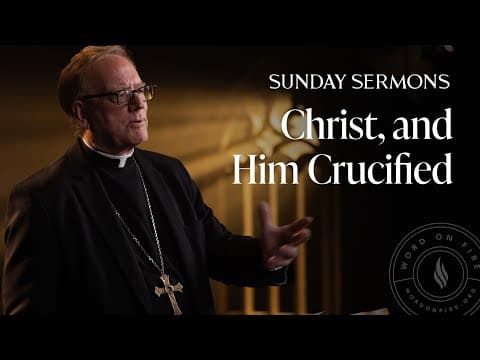
Bishop Barron's sermon on the Exaltation of the Holy Cross explores the paradox of celebrating a symbol of suffering and death. He reflects on the historical context of the cross, its brutal significance in Roman society, and how early Christians embraced it as a symbol of salvation, transforming its meaning through Christ's sacrifice.
In this year's celebration of the Exaltation of the Holy Cross on September 14th, we have a unique opportunity to delve deeper into the complexities of this significant feast. Bishop Barron invites us to reflect on the paradox of exalting a symbol that represents suffering and death—the cross.
Bishop Barron begins by sharing a personal experience from his morning holy hour in the chapel, where he is confronted by a beautiful golden cross. While its ornate design evokes a sense of prayerfulness, he reminds us that at its core, it is a Roman cross—a symbol of brutal execution. This juxtaposition raises profound questions about the nature of the cross and its significance in Christian worship.
To understand the cross's significance, we must consider its historical context. In ancient Rome, the cross was a tool of state-sponsored terrorism, used to exert control and instill fear among the populace. Bishop Barron references a scene from the HBO series "Rome," where a Roman soldier proposes to crucify men to retrieve a stolen standard. This chilling example illustrates how the cross was synonymous with power and brutality, a method of punishment that was accepted and even expected in Roman society.
The early Christians did not shy away from the reality of the cross. They acknowledged that Jesus died on a Roman cross, a fact that would have been shocking to those in the ancient world. Bishop Barron emphasizes that the first Christians preached about a crucified Messiah, embracing the irony that the one who was to save them was executed in such a horrific manner.
Bishop Barron draws a parallel between the nature of sin and the story of Adam, who sought to grasp equality with God. In contrast, Jesus, who is truly divine, chose to empty himself and take on the form of a slave, ultimately becoming obedient to death on a cross. This act of humility and sacrifice is central to understanding the Christian faith.
The cross, once a symbol of death and despair, is transformed through Christ's sacrifice. Bishop Barron articulates that the cross represents God's descent into the depths of human suffering and sin. It is through this descent that God remakes our brokenness from the inside out. Jesus' words of forgiveness from the cross signify that God's love triumphs over all forms of hatred and violence.
As we celebrate the Exaltation of the Holy Cross, we recognize that what was once a low point in Roman society has become a symbol of hope and salvation. The cross, adorned with gold and filigree, now serves as a focal point for prayer and reflection. It embodies the belief that through Christ's suffering, we find redemption and the promise of new life.
Bishop Barron concludes with a powerful affirmation: "I know one thing, Christ and him crucified." This statement encapsulates the essence of Christian faith—the acknowledgment of Christ's sacrifice and the transformative power of the cross. As we reflect on the Exaltation of the Holy Cross, we are reminded of the profound mystery of salvation that emerges from suffering and death, inviting us to embrace the hope that lies within it.



















