
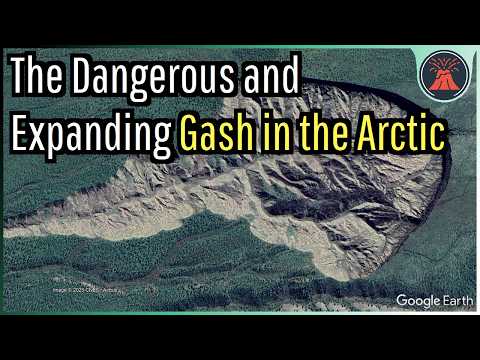
Batagaika Crater, a massive geological formation in the Arctic, is expanding rapidly due to climate change and thawing permafrost, posing significant environmental risks and highlighting the broader implications of global warming.
The Arctic region, home to over 5 million people, is facing numerous environmental hazards that are becoming increasingly apparent. Among these hazards is the alarming phenomenon of acid rock drainage, which has been observed in hundreds of locations within and near the Arctic Circle. This issue arises from rising global temperatures, which are increasing nearly four times faster in the Arctic than in other parts of the world. However, acid rock drainage is not the only concern; another significant threat is the Batagaika Crater, a massive geological formation that continues to expand each year.
Batagaika Crater is a vast gash in the tundra located 661 kilometers (411 miles) north-northeast of Yakutsk, Russia. Currently, it measures approximately 2,710 meters (8,891 feet) long, 1,000 meters (3,280 feet) wide, and 100 meters (328 feet) deep. This crater resembles an open wound in the landscape and is expanding at an alarming rate, removing the equivalent of an Olympic-sized swimming pool's volume of material every 24 hours. The ongoing erosion and collapse of the surrounding land suggest that Batagaika Crater could eventually consume an entire hillside, with the potential to destroy nearby forested areas used for logging by the end of the century.
The formation of Batagaika Crater is closely linked to the region's permafrost, a layer of ground that has remained frozen for tens of thousands to hundreds of thousands of years. In this area, the permafrost is between 300 and 500 meters (984 to 1,640 feet) thick. Permafrost acts as a solid and impermeable layer, stabilizing the landmass and preventing groundwater from penetrating it. However, as global temperatures rise, the active layer of permafrost begins to thaw, leading to significant geological changes.
The increase in temperatures has caused the active layer of permafrost to expand, eroding what was once stable ground. This process has been exacerbated by logging activities in the 1950s and 1960s, which removed root systems that insulated the active layer. As a result, the ground became more susceptible to higher temperatures, leading to the melting of ice within the permafrost. Since permafrost typically contains 20% to 85% ice by volume, the melting of this ice has caused the ground above to subside, forming a large depression that continues to expand in a positive feedback loop.
If current trends continue, it is projected that Arctic temperatures could rise by 2.8 degrees Celsius by 2100. This increase could reduce the thickness of permafrost in some areas by as much as 112 meters, potentially leading to subsidence equal to the volume of ice that previously existed. The melting of permafrost will also release greenhouse gases that have been stored in these layers, posing a significant threat to the global climate.
Despite the concerning trends, not all patches of permafrost are the same. The thickness and ice content of permafrost can vary widely across different regions. Features similar to Batagaika Crater, known as thermokarst depressions, are most likely to form in areas where permafrost is more than 50% ice by volume and is already quite thick. This variability suggests that while Batagaika Crater represents a significant environmental threat, the broader implications of permafrost thawing may differ across the Arctic landscape.
Batagaika Crater serves as a stark reminder of the dangers posed by climate change and the thawing of permafrost in the Arctic. As this geological formation continues to expand, it highlights the urgent need for global awareness and action regarding environmental issues. The implications of such changes extend beyond the immediate area, affecting ecosystems and climate patterns worldwide. Understanding and addressing these challenges is crucial for the well-being of our planet and future generations.



















