
The story of Sodom and Gomorrah serves as a powerful narrative of divine judgment against wickedness, illustrating God's mercy through Abraham's intercession. Despite the cities' wealth and beauty, their moral decay led to destruction, yet a glimmer of hope remains for those who seek refuge in God.
What if I told you a city overflowing with beauty, luxury, and prosperity vanished in a single morning? Sodom and Gomorrah were cities that had everything: wealth, power, fertile lands, and the freedom to do as they pleased. However, beneath this facade of luxury lay a people so corrupt that their cries reached the heavens. In response, God came down—not with an army or a flood, but with fire. This narrative is not merely about destruction; it is a profound story of judgment, mercy, and a man who dared to question God, asking, "Will you really destroy the righteous with the wicked?" Before the fire fell, heaven listened, and God remembered Abraham, pulling one family from the flames. This is the story of Sodom and Gomorrah.
Long ago, in the ancient lands of Canaan, two cities stood tall in the valley of the Jordan: Sodom and Gomorrah. These cities were lush and wealthy, often compared to the garden of the Lord, full of life and abundance. Travelers spoke of their luxury, but beneath their riches and beauty, darkness festered. The people of Sodom and Gomorrah had turned away from righteousness and justice, embracing violence, pride, and cruelty as their way of life. Their streets echoed with mockery and lust, devoid of songs of praise.
The prophet Ezekiel later described their sins, stating, "Now, this was the sin of your sister Sodom: she and her daughters were arrogant, overfed, and unconcerned. They did not help the poor and needy. They were haughty and did detestable things before me. Therefore, I did away with them as you have seen."
Even the angels in heaven heard the cries of the oppressed, prompting Yahweh to descend and witness the situation firsthand.
One hot afternoon, Abraham sat by the entrance of his tent in the oak groves of Mamre when he saw three men standing nearby. These were not ordinary travelers; one was the Lord himself in human form, accompanied by two angels. Recognizing their significance, Abraham rushed to meet them, offering hospitality and a feast.
After the meal, the Lord revealed the outcry against Sodom and Gomorrah, stating, "Their sin is very grievous. I will go down to see whether they have done all that has been reported. If not, I will know." As the angels proceeded, Abraham boldly approached the Lord, pleading, "Will you sweep away the righteous with the wicked?" He asked if God would spare the city for the sake of fifty righteous people, and God agreed. Abraham continued to negotiate, lowering the number to ten, and the Lord promised not to destroy the city for their sake.
As night fell, the two angels arrived at the gates of Sodom, where Lot, Abraham's nephew, sat. Despite the city's reputation for wickedness, Lot had chosen to live there, drawn by its wealth. Upon seeing the visitors, he urged them to stay at his home, knowing the dangers of the city square at night. The angels initially declined but eventually agreed to Lot's insistence.
However, before they could rest, a mob surrounded Lot's house, demanding the angels be brought out for immoral purposes. Lot, in a moment of desperation, offered his two daughters to the crowd, reflecting the moral corruption he had absorbed from his environment. The mob, enraged, threatened Lot, but the angels revealed their divine power by striking the crowd with blindness, causing panic.
The angels then urged Lot to gather his family and flee the city, as they were sent to destroy it due to the outcry against its wickedness. Lot's sons-in-law laughed at his warning, dismissing the idea of divine judgment. As dawn approached, the angels pressed Lot to leave, but he hesitated. In an act of mercy, the angels seized Lot, his wife, and his daughters by the hand and led them out of the city.
Once outside, the angels instructed them to flee to the mountains and not look back. Lot, fearing for his safety, requested to escape to a small town called Zor, which the angels permitted. As the sun rose, the Lord rained down fire and sulfur upon Sodom and Gomorrah, obliterating everything in the valley.
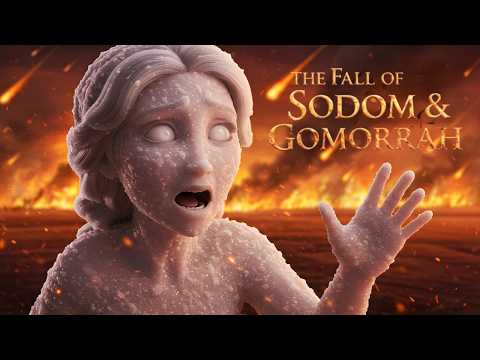
As they fled, Lot's wife looked back, her heart still tied to the city they left behind. In that moment of disobedience, she turned into a pillar of salt, a tragic reminder of the cost of longing for a life of sin. Lot and his daughters eventually sought refuge in the mountains, where a twisted story unfolded. Believing no men would come to them, Lot's daughters got him drunk and bore children by him, leading to the birth of the Moabites and Ammonites, nations that would later oppose Israel.
The story of Sodom and Gomorrah has echoed through generations, serving as a symbol of divine justice against wickedness. The cities became notorious for their arrogance, cruelty, and moral decay. Their sin was not merely their actions but their rejection of God's ways and the oppression of the innocent.
Judgment did not come suddenly; God warned, watched, and waited until mercy was exhausted. Only when the cries of the oppressed reached heaven did fire fall. Yet, even in this dark tale, there is a glimmer of hope. God spared Lot, remembering Abraham's intercession and delaying judgment until the righteous were removed.
In today's world, we see cities filled with wealth and wonder, yet plagued by arrogance, violence, and perversion. Nations once shaped by biblical values now embrace the very sins that marked Sodom. Perversion is protected as freedom, arrogance is praised as confidence, and the poor are ignored while luxury thrives. The moral decay that claims to be progress is alarming.
Scripture warns, "Righteousness exalts a nation, but sin is a disgrace to any people." Yet, there remains hope. God still listens, saves, and extends mercy to those who turn, repent, and seek refuge in Him. The fire that fell was not just punishment; it was a plea for cities, families, and individuals to awaken and remember the God who judges and saves.
Following Jesus may feel like swimming against the current, a lonely path that many reject. The pressure to conform can be overwhelming, and the voices of the world often mock our faith. However, the story of Sodom serves as a warning against following the crowd into destruction. Jesus said, "Enter through the narrow gate. For wide is the gate and broad is the road that leads to destruction, and many enter through it. But small is the gate and narrow the road that leads to life, and only a few find it."
In a world chasing shadows, Jesus is the solid rock, the true hope, and the way to life. We are called to live differently, love boldly, and shine as lights in the darkness. Stand firm in your faith, even if it feels uncool, for the narrow path with Jesus leads to abundant and eternal life.



















