
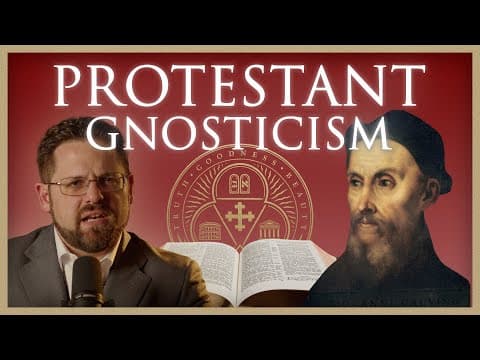
This blog post explores the author's journey from Protestantism to Catholicism, focusing on John Calvin's Gnostic approach to the canon of scripture. It examines Calvin's reliance on personal revelation and inward illumination, drawing parallels with Mormon beliefs, and critiques the implications of such a private understanding of faith.
What if I told you that one of the big reasons I'm Catholic today after being a Protestant my entire life is that I discovered John Calvin was a Gnostic with respect to the canon of scripture? Welcome to Eternal Christendom, consecrated to our Lady for the glory of our Lord. I'm Joshua Charles. Today, we will delve into a longer episode that unpacks many of the stories that took place on my road to conversion, particularly focusing on my disturbing discoveries regarding Calvin's teachings.
Our thesis today is that John Calvin's account of how Christians know the canon of scripture is fundamentally Gnostic. We will explore this in three parts:
In late summer 2017, I was a Protestant who had begun reading the Church Fathers. Their belief in Catholic doctrines compelled me to investigate whether the Catholic faith was true. I had just started reading St. Francis de Sales' The Catholic Controversy, which presents some of the best arguments against Protestantism. I was stunned by the disconnect between the teachings of the Church Fathers and those of Protestant leaders like John Calvin.
The most shocking quote I encountered was Calvin's explanation of his teaching on the canon of scripture. I discovered that his teaching was thoroughly Gnostic. For the purpose of this discussion, I define an article of faith as Gnostic if it is imparted to the individual by God directly, i.e., privately. This contrasts with a public article of faith, which God imparts to everyone through duly authorized representatives.
The Christian faith has always been fundamentally public. Christ commissioned the apostles to disciple the nations, giving them authority to teach publicly. When controversies arose, they were resolved publicly, as seen in the Council of Jerusalem in Acts 15. Thus, any claim of personal revelation contradicting the public faith is fundamentally Gnostic.
St. Francis de Sales showed me that Calvin's teaching on the canon of scripture was entirely Gnostic, undermining the basis of my Protestant beliefs, which relied heavily on sola scriptura (scripture alone). For instance, in The Catholic Controversy, St. Francis addresses the Protestant assertion that the canon consists of 66 books rather than the Catholic 73. The Protestant argument for the 66-book canon shocked me, particularly Calvin's reliance on the "testimony and interior persuasion of the Holy Spirit" to affirm his canon.
Calvin's argument for the 66-book canon is not only Gnostic but also circular. He claims that the canon of scripture is known through an inward illumination of the Holy Spirit, which he argues is superior to human judgment. This leads to a troubling implication: if only the elect receive this inward illumination, then countless Christians throughout history who disagreed with Calvin's canon must not be among the elect.
In his Institutes of the Christian Religion, Calvin explicitly states that the basis for our certainty about the canon cannot rely on anything public but rather on the secret testimony of the Spirit. He asserts that those who are inwardly taught by the Holy Spirit will implicitly acquiesce in scripture, thus dismissing the need for external authority or argumentation.
Calvin's approach effectively locks the individual within their own ego, making their subjective conviction the ultimate authority. This is a stark departure from the public nature of the Christian faith, which has always been understood to be imparted through apostolic authority.
As I continued my exploration, I realized that Calvin's arguments bore a disturbing resemblance to the appeals made by Mormons for their scriptures. Growing up in an area with many Latter-day Saints, I was familiar with their practice of asking individuals to read the Book of Mormon and seek a "burning in the bosom" as confirmation of its truth. This method parallels Calvin's reliance on inward illumination for his canon.
Both Calvin and the Mormons sidestep public authority and reason, relying instead on personal revelation. This raises critical questions: If person A claims inward illumination for canon A and person B claims a burning in the bosom for canon B, how can we determine which, if either, has the true canon of scripture? The answer lies in the distinction between private and public appeals.
The Catholic Church, as the divinely authorized witness and teacher, provides a public authority that recognizes scripture and teaches it consistently throughout history. This public nature of revelation is essential for maintaining the integrity of the Christian faith.
The common Protestant approach to the canon of scripture, exemplified by Calvin, lays the groundwork for a Gnostic understanding of faith that undermines the public nature of Christianity. This self-authentication in religious dogma has led to a broader cultural trend of self-authentication in philosophy, morality, and even personal identity.
Calvin's arguments, while perhaps not intended to lead to such consequences, have resulted in a civilizational degeneration that reflects the logical extensions of his theology. In contrast, the Catholic faith appeals to the public witness, history, and authoritative teaching of Christ's Church, ensuring that the true faith can be professed without error.
As we reflect on these insights, we are reminded of the importance of grounding our beliefs in the public authority of the Church, which has been entrusted with the power to bind and loose, rendering judgment in accordance with Christ's teachings. This is the foundation upon which we can confidently profess our faith in the one true religion, the Catholic Church.



















