
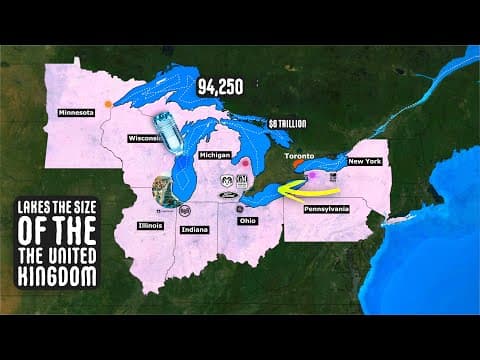
The Great Lakes region, spanning eight U.S. states and parts of Canada, is a vast freshwater system crucial to North America's development. From Chicago's rise on Lake Michigan to the industrial boom and subsequent decline, the lakes have shaped cities, economies, and cultures. Today, they support millions with fresh water, tourism, and industry, maintaining their vital role in the continent's past, present, and future.
Imagine a thousand miles of pristine coastline with white sand beaches stretching beyond the horizon, fishermen casting lines miles from shore, and thousands crowding the beachfront to enjoy the sun. While this might evoke images of oceanfront tourist spots like Jacksonville Beach or Jackal Island, this scene is actually in Chicago, Illinois. Situated nearly a thousand miles from the nearest ocean, Chicago sits on the western edge of Lake Michigan, one of the five Great Lakes.
Lake Michigan is the fifth largest lake in the world and the foundation of Chicago's rise as a major city. However, it is not the largest of the Great Lakes; it ranks third. The Great Lakes system covers 94,000 square miles, roughly the same size as the United Kingdom, encompassing London, the Scottish Highlands, Irish cliffs, and major cities like Bristol, Manchester, Birmingham, and Liverpool.
The five Great Lakes are:
These lakes are interconnected through a vast network of rivers, streams, and canals but are separated by distinct basins and elevations. Imagine five bowls of water at different heights on a table; water flows from the highest to the lowest, connecting them yet keeping them distinct.
Driving across the Great Lakes system from Duluth, Minnesota, to the Atlantic Ocean near Quebec covers approximately 1,500 miles, traversing diverse terrains from the Canadian Shield to sandy dunes and fertile soils.
The lakes hold 5,400 cubic miles of water, more than the entire Mississippi River. However, the Great Lakes are not connected to the Mississippi or Ohio Rivers. Instead, water flows from lake to lake, dropping over Niagara Falls, into Lake Ontario, and then through the St. Lawrence River into the Atlantic Ocean.
The Great Lakes mega region includes parts of eight U.S. states: Minnesota, Wisconsin, Illinois, Indiana, Michigan, Ohio, Pennsylvania, and New York, as well as parts of Canada. This region has been pivotal in the rise of the United States and Canada as economic superpowers.
By the 1950s, manufacturing in the region peaked. The 1970s saw industrial decline, and by the 1980s, Detroit's population began to fall. Despite this, the Great Lakes remained vital for shipping and industry.
Today, Chicago is home to 2.7 million people, while Detroit, Cleveland, Milwaukee, Toledo, and Buffalo each have populations of at least a quarter million. The lakes themselves have not changed significantly since infrastructure upgrades nearly a century ago but continue to influence weather patterns, including severe storms and lake-effect snow.
Tourism has grown substantially, with iconic sites like Niagara Falls remaining popular. The Great Lakes region accounts for about half of all North American tourism, contributing nearly 20% of the region's gross domestic product.
Pollution levels are declining, and the lakes provide fresh water to 30 million North Americans. The Great Lakes hold 21% of the world's fresh surface water, underscoring their environmental significance.
In the 1950s, the largest businesses along the lakes were US Steel, Bethlehem Steel, Ford Motors, General Motors, and Standard Oil. Today, the leading companies include General Motors, Ford Motors, Whirlpool, Dow Chemical, and Caterpillar. This shift reflects changes in the industrial landscape while maintaining the lakes' importance to business and economy.
The Great Lakes region is a vast and powerful system that has shaped the history, economy, and culture of North America. From its role in the rise of major cities like Chicago and Detroit to its ongoing contributions in shipping, industry, tourism, and environmental resources, the Great Lakes remain a cornerstone of the continent's identity and prosperity. Their story is one of natural grandeur intertwined with human innovation and resilience, a legacy that continues to influence millions of lives today.



















