
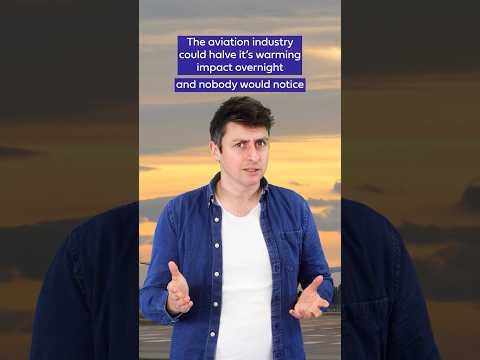
Contrails from airplanes trap heat and contribute to climate warming as much as all CO2 emissions from aviation combined. Only a small percentage of flights cause most contrail warming, and by slightly adjusting flight paths or altitudes, this effect can be drastically reduced at minimal cost and inconvenience. This approach complements long-term solutions like sustainable fuels and offers a quick, affordable way to mitigate aviation's climate impact.
The aviation industry is a significant contributor to climate change, not only through carbon dioxide (CO2) emissions but also through the formation of condensation trails, commonly known as contrails. These contrails have a potent warming effect on the climate, comparable to the total warming caused by all CO2 emissions from airplanes to date.
Flying impacts the climate in two primary ways:
CO2 Emissions: Burning jet fuel releases CO2, a well-known greenhouse gas that contributes to global warming.
Contrails: These are condensation trails formed behind planes flying through cold, humid parts of the atmosphere. Contrails act like a blanket, trapping heat radiating from the Earth's surface.
While contrails do reflect some sunlight back into space, this cooling effect is generally insufficient to offset the warming they cause. Although contrails do not persist for long periods, their warming effect is intense and significant.
Interestingly, contrails do not form on every flight. Only about 2 to 5% of flights produce the majority of contrails, which are responsible for approximately 80% of the warming effect caused by contrails. These flights typically pass through specific cold and humid patches of the sky.
The US military has long monitored and forecasted these atmospheric conditions to prevent contrails from revealing the positions of their jets. This monitoring is essentially advanced weather forecasting.
Using existing technology and weather forecasting methods, it is possible to create a system that diverts planes around the atmospheric patches where contrails form. This approach is similar to how flights are rerouted to avoid turbulence.
The required diversions are minimal — often just a 1 to 2% change in flight paths or a slight change in altitude for a small number of flights. These adjustments would add only a few minutes to flight times, such as an extra two minutes on a three-hour flight, which most passengers would hardly notice.
Implementing such a system would incur costs, but when spread across all passengers, it would amount to just a couple of dollars per ticket. This small investment could effectively eliminate the warming impact of contrails almost immediately.
To put this into perspective, avoiding the warming effect of contrails is like spending one dollar to prevent the emission of one ton of CO2. In contrast, switching to sustainable aviation fuels — another important solution — is estimated to cost hundreds of dollars per ton of CO2 avoided, potentially doubling the price of plane tickets.
It is important to emphasize that tackling contrails is not a substitute for other climate actions. Airlines must continue to pursue long-term solutions such as sustainable aviation fuels and policies like frequent flyer taxes to reduce emissions.
Addressing contrails offers a cheap and quick way to reduce aviation's climate impact now, while more comprehensive solutions are developed and implemented.
The main reason airlines have not yet tackled contrails is a lack of awareness. Passengers and the public are generally unaware that contrail avoidance is an option, so there is little demand for airlines to adopt such measures.
Raising awareness about the warming effect of contrails and the feasibility of reducing them through minor flight adjustments is crucial to driving change in the aviation industry.
Contrails represent a hidden but significant source of warming from aviation. By leveraging existing weather forecasting technology and making small adjustments to flight paths and altitudes, the aviation industry can drastically reduce this warming effect at minimal cost and inconvenience.
This strategy should be pursued alongside other efforts to reduce aviation emissions, offering a practical and immediate way to mitigate the climate impact of flying.
For those interested in learning more, data scientist Hannah Richie has written an insightful blog post on this topic, which helped inform this article.



















