
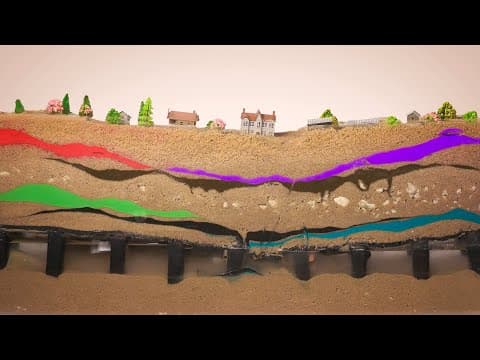
Abandoned mines pose significant risks, leading to sinkholes and subsidence that can disrupt infrastructure and communities. This blog explores the causes, effects, and modern mining practices aimed at mitigating these issues.
In December 2024, a massive sinkhole opened on I-80 near Wharton, New Jersey, causing severe traffic delays and raising concerns about the safety of the highway. This incident was not isolated; similar occurrences followed in February and March 2025, prompting the Department of Transportation (DOT) to investigate the underlying causes. What they discovered was alarming: these sinkholes were not natural phenomena but rather the result of human activity, specifically the legacy of underground iron mining that took place over a century ago.
Mining has been a part of human civilization for millennia, evolving from surface extraction to more complex underground operations as technology advanced. Initially, miners would extract visible minerals from the surface, but as demand grew, they began to dig deeper into the earth. This shift introduced new challenges, including safety risks associated with underground environments, such as darkness, flooding, and the potential for collapses.
Coal mining, in particular, drove the transition to underground methods. Coal seams, formed from ancient plant material, became a primary energy source during the Industrial Revolution. However, early underground mining practices lacked foresight. Companies often did not create detailed maps of their mines, and once resources were extracted, they abandoned the sites without considering long-term stability. This negligence has led to significant issues today, especially in areas that have since developed into populated regions.
One of the critical issues stemming from abandoned mines is subsidence, which occurs when the ground above a mine collapses into voids left behind. This phenomenon can manifest in various ways, from sudden sinkholes to gradual settling of the ground. The complexity of subsidence is exacerbated by the division of property rights, where surface rights and mineral rights can be owned by different entities, complicating accountability and remediation efforts.
Historically, the predominant method for soft rock mining, such as coal, was the "room and pillar" technique. This method involves excavating ore while leaving columns of material to support the mine's roof. However, this approach often results in minimal margins for safety, as companies aim to maximize extraction. In contrast, modern techniques like longwall mining allow for more efficient extraction but lead to inevitable surface subsidence due to the intentional collapse of the mine roof behind hydraulic supports.
Water plays a crucial role in the stability of abandoned mines. When mining operations cease, companies often stop pumping out water, leading to flooding. This flooding can dissolve soluble minerals, weaken surrounding soils, and cause erosion, further destabilizing the ground above. The effects of water on mine stability can be demonstrated through models that simulate rainfall and its impact on subsurface structures.
In 2024, a significant sinkhole appeared in a sports complex in Alton, Illinois, caused by the collapse of an underground aggregate mine. Such incidents highlight the unpredictability of subsidence and its potential to disrupt communities. The consequences can be severe, including damage to infrastructure, changes in water drainage patterns, and loss of valuable farmland.
As the legacy of abandoned mines continues to pose risks, various measures have been implemented to address these challenges. In the United States, eight states with extensive coal mining histories have established insurance pools to protect property owners from mine subsidence damage. Additionally, the federal government collects fees from coal mines to fund reclamation efforts for abandoned sites.
Modern mining regulations require companies to adopt methods that minimize subsidence and its effects. Engineers utilize a combination of empirical data, geotechnical assessments, and numerical modeling to predict and measure subsidence. Reclamation efforts can range from simple land grading to extensive structural retrofits, depending on the extent of the damage.
The story of mining is not merely one of exploitation but also one of progress and responsibility. While historical practices have led to significant challenges, ongoing efforts aim to balance resource extraction with environmental protection and community safety. Understanding the complexities of mine subsidence is crucial as we navigate the legacy of mining and work towards safer practices in the future. Mining remains an essential industry, and with continued innovation and regulation, it can evolve to meet the needs of modern society while mitigating its risks.



















