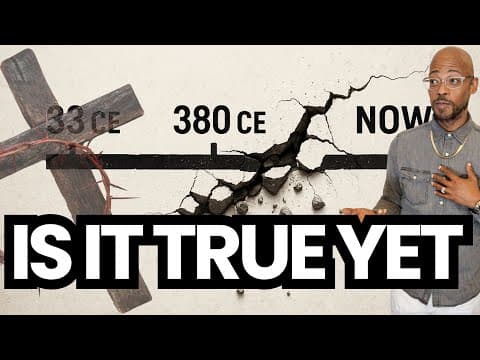
Christianity's acceptance as a true religion was not due to miracles or evidence but rather through political power, co-opting rivals, and imperial enforcement, culminating in its establishment as the sole legal religion of the Roman Empire in 380 CE.
Christianity's rise to prominence is often viewed through the lens of faith and miracles. However, a closer examination of historical evidence reveals a different narrative—one that emphasizes political maneuvering, co-opting of rivals, and the rewriting of history. This blog post explores how Christianity transitioned from a marginalized movement to the official religion of the Roman Empire.
In the first three centuries, Christianity faced significant skepticism from the educated elite of the Roman Empire. Prominent philosophers and historians explicitly rejected the faith:
These critiques came from individuals trained in logic and philosophy, who viewed Christianity as irrational and socially dangerous.
The Gospels claim miraculous events surrounding Jesus' resurrection, including mass resurrections and natural phenomena. For instance, Matthew 27:52-53 describes tombs opening and saints appearing in Jerusalem. Despite these dramatic claims, no contemporary Roman historian documented such events. Notable figures like Tacitus, Suetonius, and Philo of Alexandria, who wrote extensively about Jewish movements, failed to mention Jesus or these miraculous occurrences. The silence from these historians suggests that such events likely did not happen.
By the early 4th century, Christianity was still a fragmented and persecuted faith. The narrative surrounding Constantine's conversion is often romanticized. Contrary to popular belief, there is no contemporary record of Constantine experiencing a vision of the cross or converting to Christianity before the Battle of Milvian Bridge in 312 CE. Instead, he continued to honor pagan deities long after this supposed revelation.
Constantine's actions were politically motivated; he sought to unify the empire rather than promote Christianity. He called the Council of Nicaea in 325 CE to address theological disputes, not out of belief but to maintain peace among factions. It wasn't until Theodosius I issued the Edict of Thessalonica in 380 CE that Christianity was declared the only legal religion of the Roman Empire.
Christianity's transition from a tolerated faith to the state religion occurred in several stages:
The early Christian church also engaged in forgery to establish its authority. Eusebius of Caesarea, a prominent historian, suggested that falsehood could be justified if it served the faith. Many letters attributed to Paul are now considered forgeries, written to promote ideas that aligned with the church's growing hierarchy. This manipulation of texts was a strategic move to consolidate power and control over doctrine.
A common apologetic claim is that Jesus was a significant political threat, leading to his crucifixion. However, Roman practices indicate otherwise. Rome typically negotiated with political figures rather than executing them publicly. The swift crucifixion of Jesus, who was abandoned by his followers and executed without a significant uprising, suggests he was not viewed as a legitimate threat. Instead, the narrative of Jesus as a revolutionary was constructed later to fit theological needs.
Christianity did not become true through miracles or historical validation. Instead, it gained legitimacy through imperial endorsement and the suppression of dissent. The faith's acceptance as the sole truth in the Roman Empire was enforced by law, military power, and centuries of theological branding. The story of Christianity's rise is not one of truth triumphing over doubt but rather a narrative of power reshaping belief.
In summary, Christianity's journey from a persecuted minority to a dominant state religion was marked by political strategy, co-opting of rivals, and the manipulation of historical narratives. Understanding this history is crucial for those seeking to navigate their beliefs in a world shaped by these complex dynamics.