
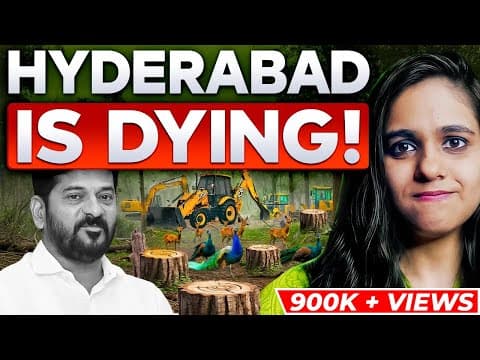
The Telangana government's plan to auction 400 acres of Hyderabad University land for an IT park has sparked widespread protests due to environmental concerns and the potential loss of biodiversity. This blog post explores the implications of this decision, the historical context of the land, and the urgent need for sustainable development.
Hyderabad is facing a critical environmental crisis as the Telangana government plans to auction 400 acres of land belonging to Hyderabad University for the development of an IT park. This decision has ignited protests from students, faculty, and environmentalists who are deeply concerned about the ecological impact of such a project.
The protests against the government's decision have been ongoing for several days, with demonstrators expressing their outrage at the destruction of a vital green space. Despite the protests, police have been removing demonstrators to facilitate the government's plans, raising questions about the prioritization of development over environmental preservation.
The Telangana government claims that the area in question lacks significant wildlife, stating there are no major animals present. However, Hyderabad University has documented over 700 flowering plants, 10 species of mammals, 15 species of reptiles, and more than 200 species of birds in the area. Notably, this land serves as a habitat for the national bird of India, the peacock.
Critics have pointed out that the government chose to push this agenda during a long weekend, coinciding with various festivals when the courts were closed. This timing raises suspicions about the government's intentions and the urgency behind the project.
The land in question has a complex history. In the 1970s, during the Telangana agitation, Prime Minister Indira Gandhi negotiated with local leaders, leading to the allocation of 2,300 acres to Hyderabad University. However, due to legal complications, the land was not officially designated as belonging to the university. In 2004, the land was allocated to IMG Bharata for a sports complex, but this company was later found to be fraudulent, leading to a prolonged legal battle.
In 2024, the High Court ruled that the land allocated to IMG Bharata was illegal, asserting that it belongs to the state government. This raises the question: does state ownership justify the destruction of a forested area for urban development?
The push for urban development often overlooks the importance of maintaining green spaces. Politicians seem to aspire to transform Indian cities into replicas of European metropolises, focusing solely on glass buildings while ignoring the essential infrastructure that supports a healthy urban environment, such as parks and greenery. This selective blindness to the consequences of urbanization is alarming, especially in a country vulnerable to climate change.
The urgency of the situation prompts critical questions: Is there truly no alternative location for an IT park in Telangana? Why is forest destruction seen as the only solution? The ongoing activities at night, including the collection of fallen logs, raise further suspicions about the government's motives and the potential for illegal activities.
The confusion surrounding land ownership in India is a significant issue. Many land records are in disarray, leading to disputes and illegal constructions. The case of Hyderabad University exemplifies this problem, as the land was intended for educational purposes but is now at risk of commercial exploitation.
In response to the environmental crisis, initiatives like Mission Mango aim to promote reforestation. Over the past four years, this project has planted 160,000 trees, emphasizing the importance of nurturing our environment. Individuals are encouraged to participate by donating mango seeds to support this cause.
Ultimately, the crisis in Hyderabad serves as a reminder that we cannot eat money or breathe it. The relentless pursuit of profit has led to the degradation of our cities and natural resources. As climate change poses increasing threats, it is crucial to recognize that our survival is intertwined with the health of our environment.
The future of India rests on the shoulders of the next generation, who must learn to appreciate the interconnectedness of all living beings. It is imperative that we share this message widely, urging others to recognize the importance of preserving our natural heritage. Together, we can make a difference, one step at a time.



















