
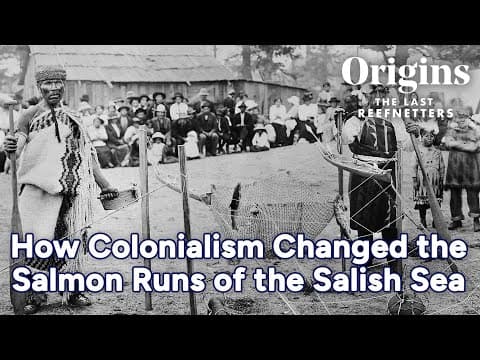
This blog post explores how colonialism has affected the salmon runs of the Salish Sea, focusing on the traditional reef net fishing practices of Indigenous peoples, the introduction of commercial fishing, and the legal battles that ensued over fishing rights.
The Salish Sea, a rich ecosystem, has been home to Indigenous peoples for thousands of years. Among the many gifts from the creator, one of the most significant is the sxole, or reef net, which has played a crucial role in the cultural and spiritual life of these communities. This blog post delves into the history of salmon fishing in the Salish Sea, the impact of colonialism, and the ongoing struggle for Indigenous fishing rights.
The reef net is described as a womb, symbolizing the connection between the salmon and the people. It is a traditional fishing method that allowed families to harvest salmon sustainably. Each family had its own fishing sites, and the reef net served as a communal tool that connected them. The spiritual significance of the sxole goes beyond mere sustenance; it embodies a deep relationship with nature and the cycles of life.
In January 1855, the Treaty of Point Elliott was signed, which included a subsistence clause guaranteeing the tribes the right to fish in their usual and accustomed fishing stations. This treaty was meant to protect Indigenous fishing rights, but its enforcement has been fraught with challenges. Historical accounts reveal that settlers observed Indigenous peoples using the reef net, but the true value of this technology was not fully understood by outsiders.
The canning industry, which began in the 1860s, marked a turning point in the relationship between Indigenous fishing practices and commercial interests. Salmon became a vital part of the settler economy, leading to increased competition for resources. The introduction of fish traps, modeled after reef nets but designed for individual profit, disrupted traditional fishing practices. These traps were highly efficient, leading to overfishing and a significant decline in salmon populations.
As commercial fishing expanded, Indigenous peoples faced increasing obstacles. Laws were enacted that restricted their fishing rights, such as prohibiting fishing gear near fish traps. This forced many Indigenous fishers out of their traditional fishing grounds. The Lummi Nation, for example, faced threats and legal challenges from commercial entities, leading to a court case in which they sought to protect their fishing rights. However, conflicts of interest among judges and lawmakers often undermined their efforts.
By the early 20th century, the impact of commercial fishing was evident. The Alaska Packers Association, a major player in the canning industry, exploited the salmon runs, leading to severe depletion of fish stocks. Reports from the 1920s describe the stench of dead salmon on Legoe Bay, highlighting the environmental degradation caused by overfishing. The fish traps operated continuously, often leading to the death of fish that could not escape.
By the 1930s, fish traps were phased out, and reef netting was reintroduced, but primarily by non-Indigenous fishers. The cultural knowledge and practices of Indigenous peoples were at risk of being lost. The U.S. government had signed treaties guaranteeing Indigenous fishing rights, yet these rights were continually infringed upon by state laws and commercial interests.
Today, there is a renewed effort to revive traditional fishing practices among Indigenous communities. The importance of passing down knowledge about reef net fishing to younger generations is crucial for preserving cultural heritage and ensuring sustainable fishing practices. The Lummi Nation, among others, is working to reclaim their fishing rights and restore the salmon runs that are vital to their identity and way of life.
The history of salmon runs in the Salish Sea is a poignant reminder of the impact of colonialism on Indigenous peoples and their resources. The struggle for fishing rights continues, as does the effort to revive traditional practices that honor the relationship between the people and the salmon. Understanding this history is essential for fostering respect and collaboration between Indigenous communities and the broader society.



















