
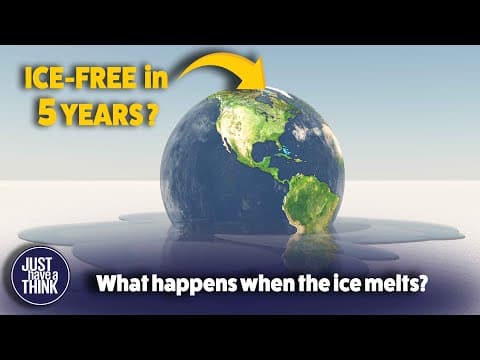
Recent research indicates that the Arctic Ocean could become ice-free as early as 2030, with significant global consequences for climate systems, ecosystems, and human life. The study highlights the urgency of addressing climate change and the potential for tipping points that could lead to catastrophic environmental shifts.
The Arctic Ocean, once a vast expanse of thick ice, is now facing a critical transformation. Recent research suggests that we may witness an ice-free Arctic Sea as early as 2030. This alarming prediction raises questions about the future of our planet and the urgent need for action against climate change.
To grasp the gravity of this situation, it is essential to understand the role of the Arctic Ocean in our global climate system. Historically, the Arctic Ocean was covered by a thick ice pack that acted as a crucial balancing mechanism for temperatures and weather patterns. This ice not only reflected sunlight back into space but also played a vital role in regulating the hydrological and carbon cycles.
A recent research paper by Céline Heuzé and Alexandra Jahn utilized advanced modeling techniques to reassess the timeline for an ice-free Arctic. Unlike previous studies that focused on when the first monthly ice-free conditions might occur, this research aimed to determine when the first ice-free day could happen. The findings were startling, with projections ranging from a conservative estimate of after the end of the century to a more alarming scenario of within the next three years.
The term "ice-free Arctic" refers to conditions where the sea ice extent falls below one million square kilometers. While this may seem like a significant area, it represents only seven percent of the total surface area of the Arctic Ocean. In such a scenario, we would likely see small pockets of thin ice along coastlines, with vast areas of open water absorbing solar energy, leading to further warming.
Interestingly, the research indicated that global greenhouse gas emissions were not the primary factor influencing the near-term projections for an ice-free Arctic. Instead, the greatest impact came from what the researchers termed "internal variability." This includes unpredictable events such as storms that can rapidly break up ice or warm ocean currents that encroach on the Arctic. These factors contribute to rapid ice-loss events, complicating predictions about the future of Arctic ice.
The implications of an ice-free Arctic are profound and far-reaching. The loss of this reflective shield would exacerbate global warming, making it increasingly difficult to keep temperature rises below critical thresholds. Furthermore, the melting Arctic could trigger a series of tipping points in Earth's systems, leading to catastrophic consequences:
These tipping points are interconnected, meaning that one event can trigger another, leading to a cascade of environmental changes. Researchers now refer to these as tipping cascades, which could result in a hothouse Earth scenario with temperatures rising by four to five degrees Celsius. Such a world would be drastically different from the one we know today, posing severe challenges for future generations.
Despite the grim outlook, there is still hope. Studies suggest that immediate and strong action to reduce greenhouse gas emissions could slow the melting of Arctic ice and stabilize conditions in the latter half of the century. Every fraction of a degree matters, as slower warming can lead to less ice loss and a reduced risk of triggering tipping cascades.
The recent findings regarding the potential for an ice-free Arctic by 2030 serve as a wake-up call for humanity. While political leaders may focus on exploiting the resources of a melting Arctic, the survival of our species and countless others depends on our ability to address climate change effectively. The time for action is now, and the future of our planet hangs in the balance.
As we reflect on this information, it is crucial to engage in discussions and advocate for policies that prioritize the health of our planet over short-term gains. The fate of the Arctic is not yet sealed, but the window for meaningful action is closing rapidly.



















