
This blog post explores the intricate logistics and engineering involved in constructing the Bekevar Wind Farm in Saskatchewan, Canada, detailing the roles of various companies, the construction process, and the environmental considerations taken into account.
Hearing about how massive wind turbines are built is one thing, but seeing it is another. Last year, I had the opportunity to visit the Bekevar Wind Farm in Saskatchewan, Canada, months ahead of its completion in November 2024. As I explored the project construction site, I witnessed firsthand the vast amount of effort it takes to get 36 turbines up and running. This experience provided insights into the nitty-gritty of permitting and safety protocols, complex transportation logistics, and the thrills of crane operation.
The Bekevar Wind Farm is a joint venture between Innagreen Investments, an investment platform for utility-scale renewable energy projects, and the Cowessess First Nation of southern Saskatchewan. The Canada division of RES, a global renewable energy company, acted as the general contractor overseeing the entire project. Canadian company Energy Wind and Renewables installed the turbines, which were supplied by the Europe-based manufacturer Nordex. Additionally, Rising Edge Group managed the transmission tasks, including drilling, cables, and the power station.
The project features 36 of Nordex's N155 turbines, each weighing several hundred tons and standing at 184 meters (over 603 feet) tall. These turbines have a power output of up to 200 megawatts, enough to cover the electricity usage of approximately 100,000 homes. Project manager Chad Serafin provided a breakdown of the turbine dimensions, noting that the hub center will be 108 meters in the air, with a rotor diameter of 155 meters.
Construction began in May 2023, with the grand opening celebrated in November 2024. The first step involved establishing a base of operations, which included building a batch plant yard and a laydown yard—centralized logistics hubs for workers and parts. Once the workers were on-site, modifications to the nearby infrastructure were necessary to facilitate turbine deliveries and access to each turbine location.
The turbine blades were transported via truck from the Port of Washington in Washington State, across the northwestern United States and into Canada. Special modifications were made to the roads to accommodate the large blades, including creating sweeps and jug handles for maneuvering around corners.
After excavating the foundations for each turbine, the next steps involved laying down a mud mat, anchor bolt cage, and rebar mat to ensure the concrete base remained upright. Following this, a crane pad was constructed to support the weight of the cranes used in the assembly process. This preparation was crucial for the safe and effective construction of the turbines.
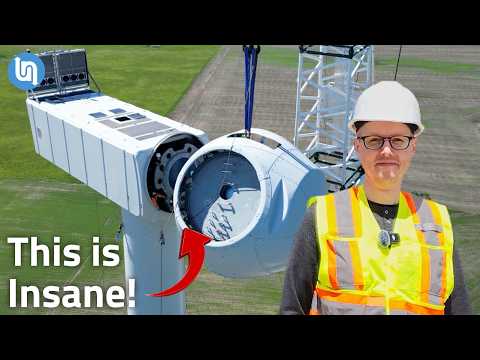
Raising the turbines was an incredible act of precision, repeated 36 times. The process began with the delivery of turbine parts, followed by the sequential raising of individual tower sections, which resembled giant tin cans. Each section was carefully stacked, and the nacelle, which contains the turbine's gearbox, was then attached. The drivetrain, responsible for converting the blade's rotation into electrical energy, followed suit.
Once the nacelle was secured, the installation of the blades commenced. This delicate operation required experienced crane operators and top-out crew installers to ensure that everything was aligned perfectly. The entire process of raising the turbines and installing the blades took about 18 hours under ideal conditions.
After the turbines were assembled, another team worked on laying the cables that connect the turbines to the power station. This process involved a machine that could dig trenches, lay cables, and refill the earth in one step, allowing local farmers to replant their crops soon after.
Environmental supervisor Cole Siddons emphasized the importance of minimizing the project's impact on the land and wildlife. The project was designed with environmental considerations at the forefront, ensuring that erosion, pollution, and wildlife habitats were protected throughout the construction process.
The electrical connections were managed at a substation designed to control and direct the flow of electricity. This facility included current transformers, voltage transformers, and circuit breakers to ensure safe and efficient operation.
Despite the meticulous planning, the project faced numerous challenges, primarily due to weather conditions. Wind speeds exceeding 11.2 meters per second (25 miles per hour) necessitated work stoppages, and during my visit, I witnessed wind speeds reaching 12 meters per second. Safety was a top priority, with daily stand-up meetings ensuring that all teams communicated ongoing challenges and safety concerns.
The Bekevar Wind Farm is expected to generate up to 200 megawatts at full capacity, with the power being sold to the Saskatchewan Power Corporation (SaskPower). Chief Erica Beaudin of Cowessess First Nation expressed excitement about the project, highlighting the importance of clean energy and the cultural significance of wind in their community.
My experience at the Bekevar Wind Farm left me in awe of the skill and care required at every step of the construction process. The coordination of operations was likened to an orchestra, showcasing the intricate logistics and engineering involved in bringing these giants to life. What are your thoughts on the level of coordination and engineering required for such projects? Join the conversation in the comments below.



















