
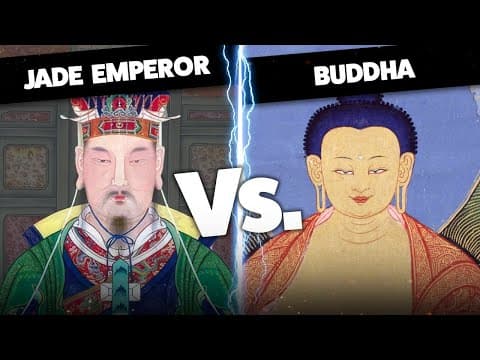
The Jade Emperor, a prominent figure in Chinese religion, embodies the complexities of Daoism and popular belief. Originally a human prince, he ascended to divine status through immense spiritual cultivation, becoming a symbol of authority and moral governance in the celestial hierarchy. His evolution reflects the interplay between Daoism and Buddhism, as well as the influence of state-sponsored worship and popular religious practices.
The Jade Emperor, known as Yu Huang in Chinese, is often referred to as the Jade Sovereign or the highest emperor. He is a significant figure in Chinese religion, ruling over heaven and commanding all gods beneath him. His image is commonly found on hell money, a ceremonial currency burned as offerings to ancestors, highlighting his popularity in Chinese culture.
The Jade Emperor's journey from a human prince to the supreme ruler of heaven is a tale of immense spiritual cultivation. Initially, he was a mortal who renounced his throne to dedicate countless lifetimes to studying the Dao. This transformation is central to his identity, as he is not merely a deity but a cosmic sage who earned his position through relentless practice and self-sacrifice.
In Chinese popular religion, which encompasses the beliefs and practices common across various communities, the Jade Emperor is viewed as the lord of heaven and the divine bureaucracy. He is often depicted in full imperial regalia, commanding respect and authority. Unlike other deities, he is accessible to mortals, often referred to as "heavenly grandfather," allowing people to appeal directly to him for urgent matters.
The Jade Emperor is particularly celebrated during the New Year, with the 9th day of the first lunar month dedicated to him. Devotees make lavish offerings at his temples, including entire roasted pigs, especially in regions like Fujian Province.
In Daoism, the Jade Emperor holds a significant but slightly lesser role compared to his status in popular religion. He ranks just below the three pure ones, the supreme deities of Daoism. Despite this, he is invoked in major rituals and has shrines in nearly every temple, indicating his importance in Daoist theology.
The primary scripture dedicated to the Jade Emperor is the "Collected Scripture on the Deeds of the Jade Sovereign," which outlines his journey from a royal prince to a fully enlightened cosmic teacher. This text asserts that he achieved Buddhahood, a term often associated with the Buddha himself, and emphasizes his role in teaching bodhisattvas the true path to awakening. Scholars argue that this narrative positions Daoism as superior to Buddhism, suggesting that the Jade Emperor outshines the Buddha in wisdom and power.
The concept of a supreme god in Chinese religion can be traced back to the Shang dynasty, with figures like Shang Di (Lord Above) and later Tien (Heaven) emerging as moral authorities. However, the fully personified figure of the Jade Emperor developed over centuries, particularly during the Han dynasty when he began to be associated with the Azure Lad, a powerful god overseeing cosmic bureaucracy.
By the Tang dynasty, the Jade Emperor became more distinct, eventually ascending to the top tier of the Chinese pantheon during the Song dynasty. This elevation was facilitated by state intervention, as emperors granted him grand titles and incorporated him into state-sponsored worship, solidifying his status as a top deity.
The rise of the Jade Emperor was not solely due to state endorsement; popular religious practices played a crucial role. Spirit writing and revelations through mediums allowed the Jade Emperor to communicate with devotees, further enhancing his popularity. His ability to issue commands and affirm the emperor's mandate through divine dreams reflects the intertwining of state and religion during this period.
As the Jade Emperor's prominence grew, Buddhist philosophers responded with both criticism and adaptation. They critiqued claims of his supremacy while also incorporating him into their cosmology, identifying him with Shakra, a well-established Buddhist deity. This dual approach allowed Buddhists to acknowledge the Jade Emperor's popularity without conceding his superiority.
In Chinese religion, gods function similarly to government officials within a divine bureaucracy. The Jade Emperor oversees a hierarchy where deities can be promoted or demoted based on their effectiveness and the rituals performed in their honor. This fluidity contrasts with other religious traditions where gods hold fixed positions.
The Jade Emperor's narrative illustrates that even divine beings can evolve, reflecting the dynamic nature of Chinese religious beliefs. His story is not just about ascension but also about the continuous interplay between human and divine realms.
The Jade Emperor's influence extends beyond religious texts into popular culture, notably in works like "Journey to the West," where he plays a pivotal role in the narrative. His character is depicted as powerful yet fallible, embodying the complexities of divine authority in Chinese mythology.
In conclusion, the Jade Emperor represents a fascinating intersection of Daoism, popular religion, and historical evolution. His journey from a human prince to the supreme ruler of heaven encapsulates the rich tapestry of Chinese religious thought and the ongoing dialogue between different spiritual traditions.



















