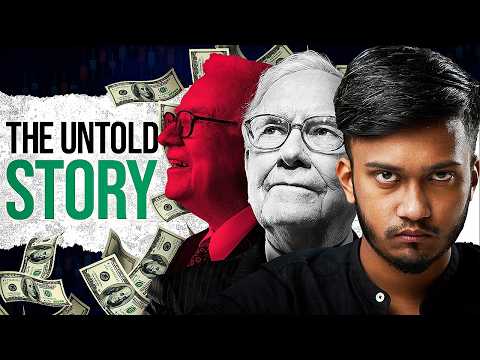
Warren Buffett's journey from a middle-class upbringing to becoming one of the world's wealthiest investors is marked by early entrepreneurial ventures, strategic investment philosophies, and a commitment to lifelong learning. Despite facing rejection and skepticism, Buffett's disciplined approach to investing and his ability to adapt led him to build a financial empire, emphasizing the importance of patience and strategic decision-making in the stock market.
Warren Buffett, known as the Oracle of Omaha, is one of the wealthiest individuals in the world today, with a net worth of approximately 135 billion dollars. His journey to success is not just about financial acumen but also about the life lessons learned along the way. This blog post explores how Buffett built his empire, the challenges he faced, and the principles that guided his decisions.
Warren Buffett was born on August 13, 1930, in Omaha, Nebraska, just a year after the onset of the Great Depression. Growing up during this tumultuous time, he witnessed the struggles of everyday people trying to make ends meet. His father worked at a bank but lost his job due to the economic downturn. Despite these challenges, Buffett learned the value of money early on.
Buffett spent much of his childhood in his father's library, where he immersed himself in books about business and investing. This early exposure ignited his passion for finance. At just six years old, he began his first entrepreneurial venture by selling Coca-Cola bottles door-to-door, earning five cents for each six-pack sold.
By the age of eleven, Buffett had pooled his savings to purchase three shares of an oil and gas company called Cities Service. He bought these shares at $8.50 each, but shortly after, their value plummeted. Remembering a lesson from a stock market book that stated, "The stock market is a device for transferring money from the impatient to the patient," Buffett decided to hold onto his shares until they reached $40. To his surprise, the shares eventually soared to $200, solidifying his belief in the principles he had learned.
After high school, Buffett enrolled at the University of Pennsylvania, where he initially pursued a business administration degree. However, he faced rejection from Harvard University when he applied for a master's program. Undeterred, he enrolled at Columbia Business School, where he met his mentor, Benjamin Graham, a renowned investor.
Buffett's time at Columbia was transformative. He recognized his introverted nature and took a public speaking course, which he later described as the best investment he ever made. This course helped him gain confidence in presenting himself and his ideas.
After graduating, Buffett worked for Graham's investment firm before returning to Omaha to start his own partnership. He converted his bedroom into an office and began managing investments. Buffett employed a strategy of buying undervalued companies, often those on the brink of bankruptcy, which he referred to as "cigar butts"—companies that still had some value left.
Despite being a teenager, Buffett's investment acumen began to attract attention. Over the next few years, his partnership's net worth skyrocketed from $15,000 to $7.2 million. However, skepticism remained due to his young age.
Buffett's investment philosophy is encapsulated in the principle of being fearful when others are greedy and greedy when others are fearful. He understood that during bullish markets, stock prices often exceed their actual value, leading to potential losses. Conversely, during bearish markets, he saw opportunities to buy undervalued stocks.
In 1968, after a decade of successful investing, Buffett dissolved his partnership, having amassed $25 million by the age of 39. He then acquired Berkshire Hathaway, a struggling textile company, and transformed it into a holding company, marking a significant turning point in his career.
Buffett's strategy evolved as he began to focus on acquiring shares of high-quality companies at fair prices. He invested in American Express and The Washington Post, among others, which saw substantial growth in their stock prices. Additionally, he ventured into the insurance business, recognizing the steady cash flow it provided, which he could reinvest.
His strategic investments in companies like Coca-Cola further solidified Berkshire Hathaway's position as a powerhouse in the business world. Buffett's approach to investing has always been about long-term value rather than short-term gains.
Despite his immense wealth, Buffett lives a remarkably simple life. He resides in a modest home and drives an ordinary car, preferring to spend time with family rather than indulge in luxury. He has pledged to donate 99% of his wealth, having already contributed billions to charitable causes.
Buffett's story is not just about financial success; it is a testament to the power of perseverance, strategic thinking, and ethical responsibility. His journey from a middle-class upbringing to becoming one of the most influential investors in history serves as an inspiration to many.
Warren Buffett's life is a remarkable example of how one decision can change the trajectory of a person's life. His commitment to learning, disciplined investing, and ethical considerations have not only shaped his career but also impacted countless others. As we reflect on his journey, we are reminded that success is not merely about wealth but also about the values we uphold and the legacy we leave behind.