
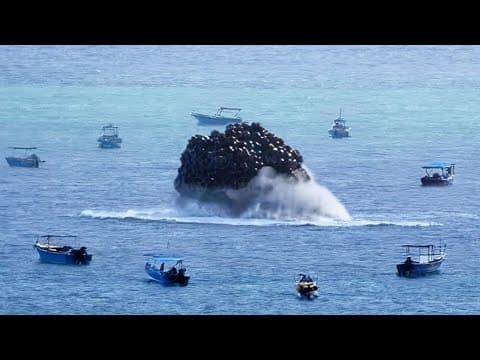
Recent discoveries reveal that fungi and microorganisms in the ocean are breaking down plastic waste, offering a potential natural solution to the growing plastic pollution crisis. While this process is slow and not a complete fix, it highlights the adaptability of life in response to human impact on the environment.
The world produces over 400 million tons of plastic every year, a figure that continues to rise. As you read this, more plastic is being manufactured, contributing to the staggering amount of waste that ends up in our oceans. It is estimated that by 2060, plastic production and waste could triple. Currently, no marine environment is untouched by plastic pollution, with waste found in surface waters, midwater layers, sediments, and beaches from the Arctic to the tropics.
Every year, approximately 12 million tons of plastic enter the oceans. However, sampling surveys detect only about 1% of that amount, leaving scientists puzzled about the missing plastic. Despite the visible garbage patches in the ocean, which are larger than continents, the levels of plastic pollution have not significantly increased over the past two decades. This contradiction led researchers to explore the possibility that the ocean is managing to deal with plastic waste on its own.
Recent studies suggest that microorganisms, particularly bacteria and fungi, are playing a crucial role in breaking down plastic. This idea is not entirely new; as far back as 2001, Japanese researchers discovered bacteria in landfills that could digest plastic. However, it wasn't until recently that scientists began to investigate the potential of marine fungi to tackle plastic pollution.
Researchers have isolated a marine fungus called Pestalotiopsis microspora, which can break down polyethylene, one of the most common plastics, at a rate of about 0.5% per day. While this may seem slow, it is a significant step forward in understanding how nature can help mitigate plastic waste. In controlled experiments, scientists found that after five months, the weight of polyethylene decreased by 7%, and polystyrene lost 11% of its weight.
In Germany, researchers discovered microfungi that thrive solely on plastics, breaking them down into simpler compounds. These fungi can reproduce on synthetic polymers without needing additional carbon sources, making them efficient decomposers of plastic waste.
The ability of fungi to break down plastic may have developed in response to the overwhelming presence of synthetic materials in their environment. Some scientists believe that we are witnessing an evolutionary adaptation, where organisms that can utilize plastic as a food source are emerging due to human-induced changes in their habitats.
For fungi and bacteria to effectively break down plastic, certain conditions must be met. UV light exposure is necessary for the plastic to undergo chemical changes that make it more susceptible to degradation. However, this process is still slow, with complete breakdown of treated polyethylene taking around 2,000 days. Despite this, the fact that plastic can be broken down at all is a significant development.
While the discovery of fungi that can digest plastic is promising, experts caution that it is unlikely to solve the plastic pollution crisis on its own. The effectiveness of these organisms is highly dependent on environmental factors such as temperature and nutrient availability. Therefore, while fungi can assist in plastic breakdown, they are not a standalone solution.
One innovative approach to utilizing fungi for environmental cleanup involves using jute bags soaked in mushroom mycelium to filter toxins from polluted water. Early experiments have shown that this method can effectively purify water from harmful substances, including dangerous bacteria like E. coli.
In addition to their potential in plastic degradation, fungi are being explored for their ability to decompose other waste materials, such as diapers. A recent study suggested that by shredding diapers and combining them with coffee grounds, researchers could create a fertilizer that allows mushrooms to thrive while significantly reducing the volume of waste.
The ocean's ability to adapt and utilize fungi to break down plastic waste is a fascinating development in the fight against pollution. While these natural processes are not a complete solution, they highlight the resilience of life and the potential for innovative approaches to environmental cleanup. As we continue to explore the capabilities of fungi and microorganisms, it is crucial to combine these discoveries with proactive measures to reduce plastic production and waste in the first place. The future may hold more surprises as we learn to work alongside nature in addressing the plastic crisis.



















