
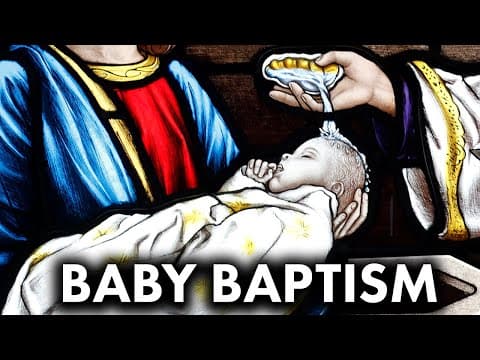
This article delves into the historical roots and evolution of infant baptism in Christianity, tracing its origins from Jewish purification rituals to its establishment as a common practice in the early church, while examining theological debates and cultural contexts that shaped its acceptance.
A few miles east of Jericho lies a spot on the Jordan River traditionally identified as the location where Jesus was baptized by John the Baptist. Today, this site attracts groups of Christians dressed in white robes, standing barefoot in the shallows, waiting for their turn to be baptized. However, the practice of baptism varies significantly among Christian denominations, particularly regarding the age of the individual being baptized. This article explores the origins and evolution of infant baptism within Christianity, highlighting its theological implications and historical context.
In many Christian traditions, particularly within Catholic, Orthodox, and some Protestant communities, baptism often involves infants. This can take the form of a few drops of water sprinkled or poured over the baby's head, or in some cases, full immersion in a baptismal font. This contrasts sharply with the image of an adult being immersed in a flowing river, as seen in the baptism of Jesus. The differences in baptism practices reflect varying theological beliefs and cultural contexts, with the age of the baptized being a significant point of contention.
In the early decades of Christianity, baptism was modeled after ancient Jewish purification practices, particularly those of John the Baptist. The term "baptism" derives from the Greek word "baptizo," meaning to immerse or plunge. Ancient Jewish customs included various water-based cleansing rituals, such as washing hands before meals and the high priest bathing before entering the Holy of Holies in the Jerusalem temple. During John the Baptist's time, many synagogues and homes had a mikvah, a ritual bath for full-body immersion, used for purification.
John's baptism diverged from traditional Jewish practices in two key ways: it was administered by another person rather than being self-administered, and it was a one-time act symbolizing entry into a religious community rather than a repeated ritual for maintaining purity. This innovation set the stage for the Christian understanding of baptism as a public initiation into the faith.
Historically, Christians initially baptized adults, as evidenced by early Christian writings. For instance, the story of the Ethiopian eunuch in Acts chapter 8 illustrates adult baptism, with no mention of children or family members. Scholar Everett Ferguson argues that adult baptism was the original norm, with infant baptism emerging later, primarily as an emergency measure for infants facing imminent death.
A significant shift occurred in late antiquity, influenced by thinkers like Augustine of Hippo, who popularized the doctrine of original sin—the belief that all humans inherit the guilt of Adam and Eve. Ferguson posits that this doctrine became the theological basis for infant baptism in the Western church, transforming it from a precautionary measure into a necessity. By the fifth and sixth centuries, infant baptism had become standard practice across much of Christendom.
Despite its eventual acceptance, infant baptism faced opposition. Tertullian, an early Latin theologian, argued against the practice, expressing concern that children baptized too early might later fall into sin, jeopardizing their salvation. He advocated for delaying baptism until a child could understand the faith. Tertullian's opposition indicates that infant baptism was already a common practice in North Africa, suggesting that it was not a fringe idea but rather a well-established custom.
Other early theologians, such as Cyprian and Origen, supported infant baptism. Cyprian argued that divine grace should not be withheld from newborns, emphasizing that baptism was an act of mercy. Origen also noted that baptism was given to infants as part of the church's practices, suggesting that the tradition was received from the apostles.
The debate surrounding the origins of infant baptism is complicated by the lack of definitive evidence. While Ferguson's model suggests a clear transition from adult to infant baptism, recent scholarship indicates a more diverse baptismal landscape in early Christianity. Scholars like Robin Jensen caution against oversimplifying early baptismal practices, noting that evidence from the second to seventh centuries reveals a variety of methods and ages for baptism.
Archaeological findings further complicate the narrative. Baptismal fonts from the early centuries show a range of sizes and depths, suggesting that both adult and infant baptisms coexisted. Some fonts were large enough for full immersion, while others were shallow, accommodating pouring or sprinkling. This diversity indicates that early Christians practiced various forms of baptism, including infant baptism, long before Augustine's time.
The rise of infant baptism may also be understood within the broader cultural context of initiation rituals in the first century. In Jewish tradition, boys were circumcised on the eighth day after birth, marking their entry into the covenant. Similarly, in Greco-Roman society, infants were often initiated into civic and social life through naming ceremonies. As Christianity spread, it is plausible that converts expected their children to be included in the faith through baptism, reflecting a shared cultural assumption.
High infant mortality rates in the ancient world may have further motivated the practice of infant baptism. Parents sought reassurance that their children were protected and included in the Christian community, regardless of theological beliefs about sin. This desire for inclusion and protection likely contributed to the growing acceptance of infant baptism as a normative practice.
The origins of infant baptism in Christianity reveal a complex interplay of theological, cultural, and social factors. While early practices primarily involved adult baptisms, the emergence of infant baptism was influenced by evolving theological beliefs, cultural norms, and the realities of life in the ancient world. The debate over its origins continues, but it is clear that infant baptism became a widely accepted practice by the early centuries of the church, shaped by a diverse array of beliefs and customs.
As we explore the historical roots of baptism, we gain insight into the development of Christian rituals and the ways in which they have adapted to meet the needs of communities throughout history.



















