
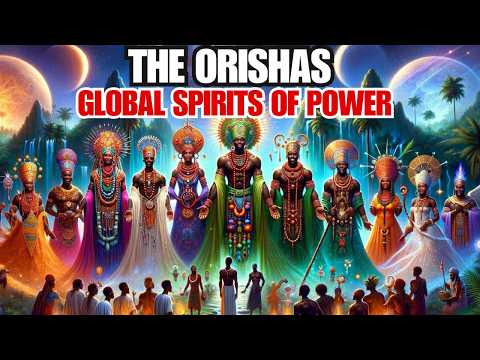
The Orishas, divine forces in Yoruba cosmology, embody nature and humanity, transcending time and geography. They survived the transatlantic slave trade, adapting through syncretism and influencing spiritual practices in Cuba, Brazil, Haiti, and the U.S. Today, they are experiencing a revival, reconnecting individuals with their ancestral roots and identities.
Before the advent of scientific explanations for lightning, before rivers were mapped and named, and before the sound of drums was dismissed as mere noise, there existed the Orishas. These divine forces of nature are not mere myths; they are the breath of existence, guardians of destiny, and messengers between worlds. The Orishas are alive, residing in the rivers, storms, fire, and metal, speaking through dreams and descending in trance, dancing through drums, and walking with those who remember their names.
In the spiritual universe of the Yoruba people, the Orishas are more than gods; they are sacred archetypes governing life, love, war, fertility, death, and transformation. Their presence has not faded with time; instead, it has expanded, crossing oceans and surviving slavery and colonization, continuing to shape the souls of millions today.
The Orishas each carry complex personalities, sacred domains, and rituals. They are gods who feel, teach, punish, protect, seduce, and sacrifice. Understanding them means entering a world where the divine and earthly are intertwined, where ancestors are never silent. The Orishas lived in the spiritual heart of the Yoruba people in West Africa, but when millions were enslaved, they traveled with them, hidden in Catholic saints and preserved through sacred dance and whispered prayers.
Before the Orishas, there was Olodare, the supreme being in Yoruba cosmology, the source of all creation, energy, and consciousness. Olodare transcends gender, time, and form, existing beyond temples and offerings. From Olodare came the Orishas, divine forces embodying various aspects of nature and humanity. The universe was given order through Olun, the ruler of the heavens, who oversees all spiritual activity.
In the beginning, the earth was formless and covered in water. Olodare, through Olaroon, sent down Obatala, the Orisha of purity, peace, and wisdom, to create land. With a chain, a calabash filled with sand, a five-toed chicken, and a palm nut, Obatala descended, forming the earth and molding the first humans from clay. This myth reveals the deeply human nature of the Orishas, who, despite their divine status, carry emotions and consequences.
Following Obatala's mission, other Orishas were dispatched, each with unique duties:
Each Orisha embodies divine principles, reflecting Olodare's infinite nature. They guide humanity, with each person believed to have a head Orisha, a spiritual guardian shaping their destiny.
In Yoruba cosmology, the spiritual hierarchy consists of:
When chaos strikes, it is seen as a disruption of balance. Through rituals, prayers, and sacrifices, the community works to restore harmony with the Orishas and the fabric of life.
The Orishas did not remain in Nigeria; they traveled across the Atlantic, hidden in the hearts of enslaved Africans. Despite attempts to erase their spirits, the Orishas survived through transformation and adaptation. They reshaped themselves through syncretism, blending African spirituality with European religious imagery, particularly Catholicism.
In Cuba, Yoruba spirituality merged with Catholicism to create Santería, aligning Orishas with Catholic saints. In Brazil, Candomblé emerged, celebrating Orishas through elaborate ceremonies. In Haiti, Vodou developed, blending Yoruba beliefs with other African traditions. These spiritual practices became acts of rebellion against oppression, allowing the Orishas to thrive.
Today, the Orishas are experiencing a revival, reconnecting individuals with their ancestral roots and identities. Across the globe, altars to Yamaya can be found in Miami, Oshun prayers in Toronto, and Shango drummers in Paris. Digital platforms have become spaces for sharing rituals, decoding myths, and building global communities rooted in ancestral truth.
This revival is not merely a trend; it is a reconnection to a spiritual lineage that refused to die. Invoking the Orishas is a declaration of dignity, a refusal to accept narratives that demonize their traditions. The ceremonies, altars, and songs are acts of resistance and rebirth.
The Orishas are not relics of the past; they are the future of a spiritual lineage that continues to thrive. They remind us that we are not alone, that the sacred breathes through the earth and through us. To walk with the Orishas is to step into a divine lineage intertwined with nature, spirit, and human experience. Their stories are mirrors reflecting our choices, healing, justice, and love. The Orishas are waiting, and the path to reconnect with them is still open.



















