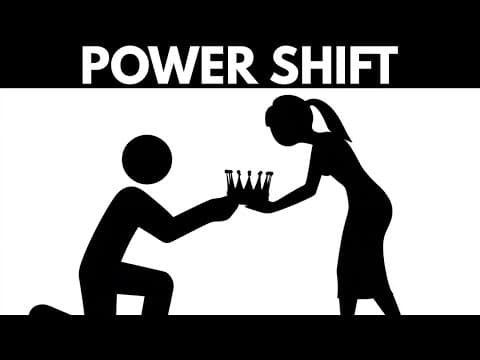
This article explores the psychological dynamics behind why men often fall harder for women who let them go. It delves into the implications of a woman's peaceful departure, highlighting how it challenges a man's self-perception and prompts introspection, ultimately leading to personal growth.
Letting someone go is rarely seen as a position of strength. In popular imagination, we associate holding on with care, love, and investment. However, what is often overlooked is the psychological weight behind the decision to let go, especially when a woman chooses to walk away with quiet certainty. This act communicates a profound message: she does not define her worth by someone else's ability to stay. Paradoxically, this is often the moment when many men begin to fall for her, perhaps harder than ever before.
When a woman walks away peacefully, she conveys a psychological truth: "I do not need to be chosen in order to have value." This simple yet profound realization has deep implications. Many relationships, particularly those rooted in insecurity, are based on an unspoken power imbalance. One partner may lean heavily on being needed, while the other leans on being wanted. When a woman subverts this dynamic by operating from self-sufficiency, it disrupts the subconscious gears of control and validation that many men are unaware they are turning.
If she does not beg, prove herself, or spiral into reactive behavior, what remains? Only her silence, distance, and calm departure, which communicate strength and inner authority. She is not exiting due to pain; she is leaving because her values outweigh the situation. This sends a powerful signal to the male psyche: he was not dealing with someone who was trying to be loved, but with someone who already loved herself. Such women are rare, and when they leave, the space they vacate feels larger and more pronounced because it is born of clarity, not dysfunction.
Human attraction is not merely about surface-level traits like looks or shared hobbies. At its core, especially for men, it is about psychological magnetism toward what is stable, rare, and self-sustaining. A woman who does not chase, cling, or crumble becomes psychologically distinct—not cold or indifferent, but resolute. She knows her boundaries and is willing to pay the price of solitude rather than compromise her self-respect. This is not weakness; it is sovereignty.
When a woman walks away with grace, she challenges a man's integrity and maturity. She does not attack or shame him; instead, she leaves him to confront the reality he created. This form of influence is far more powerful than any reactive behavior could ever hope to be.
In Jungian psychology, there is a concept called "thema," which refers to the internal feminine within the male psyche. When a woman exits with strength and dignity, it stirs this aspect within a man—not as a projection of fantasy, but as a confrontation with what he has yet to become. He sees the grace she embodies and recognizes that he could have matched it but did not. This realization creates a source of quiet torment.
When people ask, "Why does he fall harder after she lets him go?" the answer is layered. It is not solely about loss; it is about being confronted with a version of femininity that is self-possessed and not dependent. It is about realizing too late that love was not meant to be won through dominance or delay; it was already there, already offered, but not at the expense of her dignity.
In this realization, something collapses: the illusion of control, the belief that there would always be more time, and that she would always be available. What remains is the haunting recognition that she did not stop loving; she simply stopped waiting. This kind of letting go does not disappear; it lingers and rewrites the narrative. It challenges the ego in ways that no argument ever could.
If you are the one who walked away, especially with grace, do not mistake his silence for indifference. The absence of reaction does not equate to the absence of impact. Sometimes, the most significant realizations occur in the quiet reflection that follows your exit. Letting go is not the end of your power; it is often the beginning of it.
People remember who had the courage to walk away with their head held high, not those who clung to them in desperation. When a woman moves on with genuine peace—born not of indifference or repression but of deep inner work—it creates a mirror for a man who has not done that work himself. Her stillness contrasts sharply with his internal disorder, triggering profound realizations.
Men are often not encouraged to explore their internal landscape. They are taught to achieve, conquer, and provide, but rarely to feel deeply or confront unresolved emotional entanglements. When a man sees someone he once had access to—someone who once influenced him emotionally—now composed and unbothered, he is forced to reckon with what he is not: not peaceful, not whole, and not fully in control of his emotional machinery.
The male ego, particularly when underdeveloped, seeks reassurance. It wants to know that it mattered, that it left a mark, and that it is still in control of the emotional narrative. However, when a woman walks away and genuinely flourishes, the man is left with only one person to confront: himself. This is not about casting blame or painting men as fragile; it is about the psychological disorientation that occurs when someone who once reflected your dysfunction back at you suddenly stops.
The game changes, and the loop is broken. What once filled the space between them—conflict, passion, drama—dissolves, leaving a vacuum that can be terrifying. In the absence of external distraction, a man is left with the internal mess he has been avoiding. He can no longer use her reactions to justify his behaviors; her peace exposes his disarray.
Peace in a partner is not something one stumbles upon every day in a world wired for instant gratification and emotional highs and lows. It is a discipline, a byproduct of accountability, emotional honesty, and often real suffering transmuted into wisdom. When a man witnesses a woman embodying this kind of peace after a separation, it does not just remind him of her strength; it reminds him of his missed opportunity.
He remembers not only the version of her that once struggled to hold the relationship together but the version that grew beyond needing to. This evolution—not the distance or silence, but the change—is what haunts him. Deep down, even if he never admits it, part of him hoped she would not change, that she would remain tethered to the same cycles, that she would wait, and that her emotional chaos would remain a mirror for his.
When she finds order rooted in authenticity and peace, the illusion collapses. The psychological dissonance intensifies as the man is caught between admiration and regret. He may feel pride watching her evolve, but it is accompanied by the sting of absence. She is no longer his to affect, and perhaps more unsettling is the realization that she never truly belonged to him in the first place; she chose him and has now unchosen him—not through hatred or vengeance, but through clarity.
When a woman finds her peace, she becomes untouchable—not because she builds walls, but because she no longer reacts from woundedness. This shift is deeply unsettling for someone used to connecting through emotional volatility. Her serenity disrupts the pattern and breaks the unspoken pact to stay wounded together.
The man is left with a choice: regress into blame, denial, or distraction, or rise. He can either continue trying to fill the silence with noise or enter that silence himself—not to chase her, but to finally meet the parts of himself he avoided when she was still emotionally accessible. This is the gift hidden in her peace; it is not a punishment but a call to awaken, grow, and face the internal chaos he has kept buried under rationalizations and distractions.
Men often do not forget the women who let them go because they were not just losing a partner; they were losing the mirror. What was once external now demands to be found within. The takeaway is clear: peace is powerful. It is more confronting than anger, more enduring than sadness, and far more transformational than resentment. It speaks in silence and heals in absence.
Never underestimate the impact of your inner work. When you choose peace over performance, healing over hostility, you do not just change your life; you change the emotional ecosystem around you. Sometimes, that is what finally compels the other to grow. True influence does not always come through presence; sometimes, it comes through the clarity of your absence.
When a woman lets go not out of resentment but out of resolve, she delivers a form of psychological pressure that few men are prepared to handle. It does not provoke a fight or offer a clear villain; it simply leaves him where he is, with no distractions, no emotional chaos to point to, and no version of her to project upon. It creates a space where he must finally confront something he may have avoided for years: the fact that he has not moved.
In the end, when a woman finally lets go, something shifts—not just in the relationship dynamic but in the psychological landscape of the man she walked away from. Her absence speaks volumes, offering a powerful form of truth that says, "I cannot carry both of us anymore. You must confront the emptiness I once protected you from." This moment can define the next chapter of his life, as he faces the choice to evolve or remain as he is. The paradox of growth reveals that what feels like loss is often the first step toward becoming who one was always meant to be.