
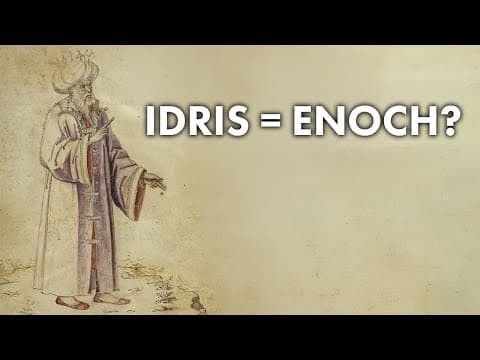
The Islamic prophet Idrīs is a mysterious figure often identified with the biblical Enoch. Both are associated with divine wisdom and an ascent to heaven. While the Quran mentions Idrīs briefly, later Islamic traditions link him to Enoch and even to Hermes Trismegistus, blending Hebrew, Persian, Greek, and Arabic traditions into a unique esoteric figure revered for secret knowledge and righteousness.
Few prophets in Islam are as mysterious as Idrīs. Commonly identified with the biblical prophet Enoch, Idrīs is considered an esoteric figure associated with secret wisdom and the mysteries of creation. However, most of what is known about Idrīs does not come directly from the Quran but from layers of commentary, legend, and interpretation that developed over time.
Idrīs appears only twice in the Quran. In Sura 19, he is described as a man of truth and a prophet who was raised to a high position by God. He is called Siddiq, meaning truthful or totally faithful to God, a title shared only with Abraham in this passage. This highlights Idrīs's special status but does not elaborate on his identity.
In Sura 21, Idrīs is mentioned alongside Ishmael and Du'l-Kifl as steadfast and righteous individuals admitted to God's mercy. Du'l-Kifl's identity is unclear, adding to the mystery surrounding Idrīs. His name itself does not have a clear Arabic origin and may derive from roots related to studying or learning, or possibly from names like Ezra or Elijah.
Enoch, a figure in the Hebrew Bible, is the great-great-grandfather of Noah and is known for his mysterious life. Genesis states that Enoch "walked with God" and was taken by God at 365 years old, implying he did not experience death.
Jewish apocryphal literature, especially the First Book of Enoch, expands on his story with visions of heaven, fallen angels, and prophecies. Later texts identify Enoch with the archangel Metatron, a celestial attendant to God.
Early Christians also revered Enoch as a model of faith and a prophet who foresaw divine judgment, as referenced in the New Testament books of Hebrews and Jude.
Muslim scholars began associating Idrīs with Enoch within the first century of Islam. Early Hadith compilers like Wahb Ibn Munabbih explicitly identified Idrīs as the Arabic name for Enoch, stating that Idrīs received divine revelation and special knowledge centuries before Muhammad.
The Quranic phrase that God "raised him to a high position" is commonly interpreted as Idrīs being taken to heaven, paralleling Enoch's ascent. Islamic cosmology describes seven heavens, with the fourth heaven, Ma'una, sometimes considered Idrīs's eternal home alongside the Angel of Tears (Cassiel).
Some Muslim scholars further linked Idrīs to Hermes Trismegistus, a legendary sage associated with hermeticism—a tradition encompassing philosophy, alchemy, astrology, magic, and medicine. Hermes Trismegistus is a syncretic figure combining the Egyptian god Thoth and the Greek god Hermes, both patrons of knowledge.
Hermetic texts, especially the Corpus Hermeticum, date from 100 to 300 CE and were influential in both the ancient and Renaissance worlds as sources of occult wisdom.
In the Muslim world, Hermes was interpreted differently. The title "Trismegistus" (thrice great) was understood as referring to three separate figures named Hermes, each from different historical periods: one before the flood, one after, and one long after the flood. The first Hermes is consistently identified with Enoch/Idrīs.
This tradition likely entered Arabic literature through Greek sources during the early Islamic period. The Jewish astrologer Abū Maʻshar al-Balkhī, in his now-fragmentary work Kitab al-Ulüf (The Book of the Thousands), described Hermes as a title and identified the first Hermes as Enoch/Idrīs, blending Hebrew, Persian, Arabic, and Greek traditions.
Idrīs remains a fascinating and enigmatic figure in Islamic tradition. While the Quran provides limited information, later interpretations and cross-cultural influences have enriched his story. Identified with the biblical Enoch, Idrīs is revered as a prophet who was raised to heaven and bestowed with divine wisdom. The further association with Hermes Trismegistus connects him to a broader tradition of esoteric knowledge spanning multiple cultures and epochs, highlighting his role as a primordial sage and bearer of secret wisdom.
This complex identity of Idrīs illustrates the rich tapestry of religious and philosophical ideas that have influenced Islamic thought and its engagement with earlier traditions.



















