
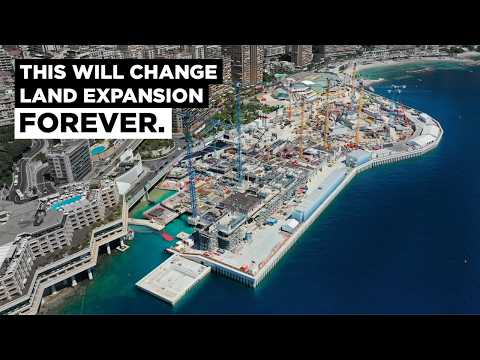
Monaco, the second smallest country in the world, faces a space crisis due to its dense population and limited land. To address this, it has invested $2 billion in land reclamation, creating Mareterra, a new district that expands its territory into the Mediterranean Sea. This project not only increases housing but also incorporates innovative engineering and environmental preservation techniques, setting a potential gold standard for future land reclamation efforts.
Monaco is a tiny nation, the second smallest in the world, with an area that could fit into Central Park. Known for its glamorous events, particularly the Monaco Grand Prix, the country is a playground for the rich and famous. However, its small size presents significant challenges, particularly in terms of population density and space.
Monaco is the most densely populated country globally, hemmed in by France and facing a severe space crisis. With only two miles in length and one mile in width, the nation has limited options for expansion. The only feasible direction for growth is into the Mediterranean Sea. This necessity led to Monaco's ambitious $2 billion project to expand its landmass through land reclamation.
Historically, Monaco was larger than it is today. In 1861, the principality ceded 95% of its land to France in exchange for recognition as a sovereign state and four million francs. Today, this small area is home to approximately 37,000 residents, and since the 1950s, the population has nearly doubled, increasing the demand for housing and space.
Monaco's latest land reclamation project, Mareterra, adds six hectares to its territory, increasing its area by 3%. This project is part of a long history of land reclamation in Monaco, which has grown by over 20% since 1880. Mareterra is designed to be environmentally friendly, featuring a curved footprint that respects the natural flow of the sea, and incorporates state-of-the-art engineering techniques.
The Mediterranean Sea is rich in biodiversity, home to nearly 6,000 species, including the vital seagrass, Posidonia oceanica. As part of the Mareterra project, marine biologists relocated large sections of this seagrass to minimize ecological disruption. Approximately 500 square meters were transplanted using the sod method, which mechanically moves large areas of seagrass to new locations, ensuring their survival and promoting biodiversity.
The construction of Mareterra involved a team of skilled engineers and marine biologists, including notable figures like Renzo Piano and Denis Valode. The project utilized caissons—large watertight boxes—to create a barrier that prevents fill material from floating away. Over three years, contractors dredged silt from the seabed to expose bedrock for caisson construction, employing submerged anti-turbidity screens to minimize environmental impact.
In total, 18 caissons, each weighing about 10,000 tonnes, were constructed in Marseille and transported to Monaco. The caissons were filled with over 1.5 million tonnes of rock and marine sand to create the new landmass. Remarkably, these structures also serve as habitats for marine life, fostering algae growth and enhancing biodiversity.
Mareterra is designed to be the greenest part of Monaco, featuring a seafront promenade, parks, a marina, retail spaces, restaurants, and cultural venues. The development aims to contribute to the economic and social vibrancy of the principality. Each structure is designed to be adaptable to rising sea levels, with moving piers that can adjust to prevent flooding.
Despite the success of Mareterra, questions remain about whether this 3% expansion is sufficient for Monaco's future needs. The project is already reaching depths of 50 meters below sea level, making further land reclamation challenging due to steep underwater topography and ecological concerns. As the global population is projected to reach 10 billion in the next 75 years, Monaco must consider alternative solutions for future growth.
One potential solution could be inspired by the Maldives, which is developing a floating city to combat rising sea levels. This city will consist of connected hexagonal islands anchored to the seabed, allowing for movement with ocean currents. While challenges remain, such as water depth and power generation, floating cities present a viable option for future urban development.
Additionally, building upwards could be considered, although Monaco's mountainous terrain and historical architecture limit the feasibility of new skyscrapers. The tallest building in Monaco, the Odeon Tower, stands at 170 meters, but further vertical expansion is unlikely due to geological and aesthetic constraints.
For now, Monaco can take pride in the successful completion of Mareterra, which seamlessly integrates into the coastline and addresses immediate housing needs. However, the future remains uncertain as the population continues to grow. Mareterra stands as a testament to innovative land reclamation and could serve as a model for similar projects worldwide, showcasing what is possible when engineering meets environmental stewardship.



















