
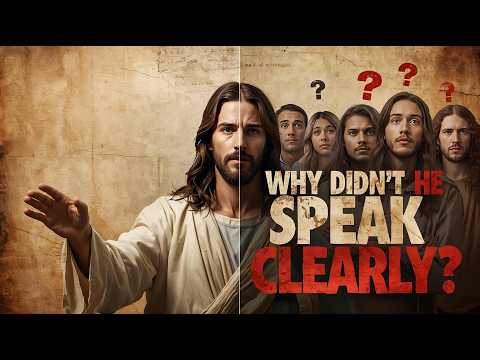
This article explores why Jesus spoke in riddles rather than clear teachings, examining the implications of ambiguity in religious texts. It discusses how this obscurity fosters dependency on authority figures, creates division among believers, and raises questions about the nature of truth in religious teachings.
When examining the teachings attributed to Jesus, one of the most striking features is his frequent avoidance of straightforward answers. Instead of delivering clear messages, he often communicates through parables, metaphors, and puzzling imagery. This raises an important question: if his message was meant to convey the most significant truth in human history, why did he choose to speak in riddles?
The gospel writers themselves grapple with this issue. In the Gospel of Mark, Jesus explicitly states that he speaks in parables so that outsiders may be ever seeing but never perceiving, and ever hearing but never understanding. This approach seems less like a teacher imparting wisdom and more like someone intentionally withholding it. If salvation hinges on understanding these teachings, why hide the message behind layers of symbolic storytelling?
To understand this phenomenon, we must consider the cultural context of teaching during Jesus's time. Jewish rabbis often used stories to clarify points, aiming to make lessons memorable rather than obscure. Jesus's method of deliberately cloaking meaning stands out as unusual, suggesting that this obscurity was a conscious choice with significant consequences.
From a psychological perspective, riddles and parables serve a specific function: they create a sense of mystery. This mystery keeps listeners engaged, not because they understand, but because they are compelled to seek answers. The uncertainty encourages emotional investment in solving the puzzle. However, when applied to matters of eternal consequence, this tactic can feel manipulative, fostering dependency rather than empowerment.
The ambiguity in Jesus's parables leads to radically different interpretations across Christian traditions. For instance, the parable of the sower or the prodigal son can yield numerous explanations, reflecting the biases of those interpreting them. This flexibility has contributed to the fragmentation of Christianity into thousands of denominations, as each group claims its interpretation as the true one while dismissing others as mistaken.
The use of metaphorical language also serves a social control function. When teachings are wrapped in ambiguity, authority figures gain the role of interpreters. The average believer cannot simply read and understand; they must rely on priests, pastors, or theologians. This creates a hierarchy where the power of interpretation is concentrated at the top, ensuring that ambiguity keeps the hierarchy intact.
Some defenders of Jesus's parables argue that he used them to reveal truth only to those who were ready. However, this reasoning falters when considering the stakes involved. If the truth of life and death is at stake, why restrict understanding to an inner circle? Would a doctor hide a cure for a deadly disease in riddles, expecting only the clever to decipher it? The contradiction between the supposed urgency of the message and its obscurity is difficult to reconcile.
Another angle to consider is whether the obscurity was not intentional at all, but rather a later literary device added by the gospel writers to elevate Jesus above other teachers. If he spoke plainly, he might seem like just another rabbi. However, by speaking in riddles, he could be portrayed as a mystical figure whose words carry hidden depth. This framing allows for endless analysis and reinterpretation, transforming a simple preacher into a cosmic mystery.
Stripping away the layers of mystique reveals that many parables are not profound at all. For example, the parable of the mustard seed conveys that the kingdom of God starts small and grows large—an insight that is hardly earth-shattering. Yet, when framed as a mysterious parable, it gains an aura of significance that it does not inherently possess. By speaking in riddles, even simple ideas can be elevated to the status of divine revelation, but this elevation comes at the cost of clarity.
The flexibility of parables allows them to be endlessly adaptable, but also endlessly unclear. This pattern fits a broader truth about religion: beliefs built on ambiguity tend to survive longer. Clear predictions can be tested and disproven, while vague symbols can be reinterpreted indefinitely. The very obscurity of Jesus's riddles may be the reason they have endured, creating an elastic framework that can stretch across cultures and centuries.
Ambiguity creates the illusion of intimacy, as listeners project their own situations and struggles onto the stories. Psychologists refer to this phenomenon as the Barnum effect, where vague statements resonate with nearly everyone. This technique can be comforting, allowing believers to feel that divine wisdom is tailored specifically to them, but it also shields the text from accountability.
In contrast to how we typically view communication, the responsibility for clarity in religious teachings often falls on the audience rather than the speaker. If a scientist presents data that is not understood, the onus is on the scientist to clarify. However, in religion, obscurity is often treated as depth, and confusion is reframed as mystery. This dynamic protects the religion from criticism while keeping followers in a cycle of striving for understanding.
The practical implications of this ambiguity are evident in religious debates. Take the parable of the talents, for example. Some interpret it as a call to use one's gifts wisely, while others frame it as a metaphor for economic responsibility. This flexibility is not a strength; it is a symptom of vagueness. The same story can be used to support opposite political or moral agendas, demonstrating how ambiguity can be weaponized.
The historical context in which these stories were written down also plays a role. Decades passed between Jesus's teachings and the writing of the gospels, allowing for fluid oral traditions that changed with each retelling. The riddling quality may not even belong to Jesus himself but could be a product of editing and literary framing by later writers.
If the most important truths about existence, morality, and salvation are wrapped in puzzles, how are ordinary people supposed to find their way? If eternal destiny hangs in the balance, why make communication so cryptic? The answer may be simpler than it appears: clarity was never the goal. Instead, the focus was on authority, mystery, and survival, and riddles serve all three.
The ambiguity of parables ensures that authority figures remain indispensable. Without the riddle, there would be no need for constant reinterpretation, and the audience would not need to return for further explanations. This dynamic mirrors how cults often operate, where leaders speak in cryptic terms, making followers work harder to grasp the message. This effort creates a sense of investment, making it less likely for individuals to walk away and admit the message was meaningless.
When we step back, the supposed wisdom in many parables begins to look thin. The parable of the Good Samaritan, for instance, is often praised as a call to compassion, but stripped of its religious framing, it is simply a story about helping a stranger. Humanity has understood the value of kindness long before Christianity. Wrapping it in religious mystery only makes it seem more profound than it is.
In hostile environments, Jesus sometimes avoided direct statements to protect himself from arrest or silencing. Speaking in riddles allowed him to make claims without making them explicit, enabling his followers to grasp one layer of meaning while outsiders heard only harmless stories. However, this raises an uncomfortable point: if the survival of a teacher requires ambiguity, then the clarity of truth is sacrificed for safety.
Riddles trigger cognitive bias, as the brain works harder to resolve tension in confusing statements. This extra mental effort creates stronger memories. Parables stick in the mind not because they are profound, but because they are difficult. The difficulty tricks us into assigning more value to the content, leading us to equate effort with importance.
If clarity were the goal, the method chosen was disastrously poor. Riddles may keep people talking, but they do not provide reliable guidance. Look at the world today: billions claim allegiance to the same teacher, yet they live by radically different interpretations of his riddles. Some justify war, while others preach peace. The words themselves cannot settle the debate because they were never clear in the first place.
The cycle of confusion and control perpetuates itself. If clarity were achieved, the search for understanding would end. But as long as meaning is hidden behind riddles, the search never stops. This cycle sustains religious institutions generation after generation, as followers continue to seek guidance from authority figures.
The danger of ambiguity is that it can be weaponized. The parable of the sheep and goats, for example, has been used to inspire compassion for the poor, but it has also been used to draw harsh lines between insiders and outsiders. A single story can be interpreted in vastly different ways, depending on who wields it as moral authority.
If the most important message in history exists, it should not need decoding. It should not require priests, pastors, or theologians to unlock. It should not leave billions of people divided, confused, or condemned because they solved the puzzle differently. Truth should be clear. If it isn't clear, then maybe it isn't truth.
In conclusion, the question of why Jesus spoke in riddles instead of being clear reveals uncomfortable truths about the nature of religious teachings. Riddles sustain authority, build mystery, and ensure survival, but they also create dependency, division, and confusion. The enduring nature of these riddles does not equate to their truth. Instead, they serve as tools of communication that exploit human psychology and cultural dynamics to maintain control. The tragic irony is that countless individuals have suffered due to this ambiguity, while the same riddles have also inspired kindness and compassion. Ultimately, the legacy of Jesus's riddles is one of complexity, reflecting the intricate interplay between authority, interpretation, and the search for meaning in human existence.



















