Enron's dramatic rise to prominence as a leading energy company ended in a catastrophic bankruptcy in 2001, revealing widespread fraud and mismanagement. This blog post explores the company's history, the accounting practices that led to its downfall, and the lasting impact of the scandal on corporate regulations.
At the start of 2001, Enron was hailed as a model corporation, boasting 30,000 employees and an annual revenue of $100 billion. However, by the end of that year, it had become synonymous with the largest bankruptcy in American history. This blog post delves into the factors that led to Enron's meteoric rise and catastrophic fall, highlighting the themes of fraud, corruption, and mismanagement.
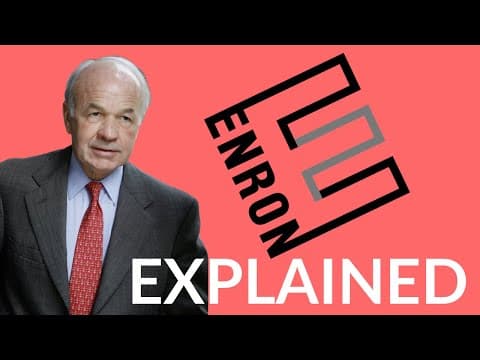
Enron was founded in 1985 through the merger of InterNorth, an energy firm, and Houston Natural Gas, a utility company. Ken Lay, an American businessman, was appointed as CEO. The company’s logo, the infamous Enron E, was designed by Paul Rand, a legendary artist known for creating logos for major corporations like IBM and UPS.
The energy market underwent significant deregulation throughout the 1980s and 1990s, leading to volatile prices and a belief that anything was possible as companies capitalized on the bull market following the 1987 stock market crash. Enron seized this opportunity by opening its own trading subsidiary, which allowed it to maximize profitability.
In 1991, Jeffrey Skilling was appointed CEO of Enron Capital & Trade. Under his leadership, the company adopted mark-to-market accounting, a practice that allowed it to value its assets based on future price predictions rather than historical costs. This accounting method effectively gave Enron the ability to report inflated profits without accountability for the accuracy of its valuations.
As a result, Enron's revenue figures soared throughout the 1990s. The company was named Fortune's best company to work for in 2000, and its stock price peaked at $90 per share. Enron continued to invest heavily in various projects, both domestically and internationally, while masking its losses through optimistic asset valuations.
To cover reported losses and cash flow issues, Enron borrowed money from its Special Purpose Vehicles (SPVs), which were subsidiaries capitalized with Enron stock. This arrangement made it nearly impossible for lenders to recover their investments if Enron faced financial difficulties.
The bursting of the dot-com bubble in 2000 severely impacted Enron's assets, as the company had diversified into industries such as video on demand and high-speed broadband networks. Investor skepticism grew regarding Enron's complex business model, leading to increased scrutiny of its financial statements.
In early 2001, Ken Lay stepped down as CEO, handing the reins to Skilling. However, Enron's stock price halved to $40 within six months, prompting widespread speculation about the company's accounting practices. Skilling resigned in August 2001, and Lay returned as CEO amid declining stock ratings and mounting concerns.
In October 2001, Enron announced its first quarterly loss in four years, attributing it to a billion-dollar charge from underperforming assets. The Securities and Exchange Commission (SEC) launched a formal investigation into the company's financial statements. In November, Enron revealed it had overstated its profits by $591 million between 1997 and 2000.
As the situation worsened, a merger with competitor Dynegy was proposed but ultimately fell through due to concerns about Enron's lack of transparency regarding its off-balance-sheet debt. By the end of November, Enron's stock price plummeted to just 26 cents per share, down from $80 earlier that year. On December 2, 2001, Enron filed for bankruptcy protection, marking a swift decline from being the seventh-largest corporation in the United States.
The fallout from Enron's collapse was devastating. Thousands of employees lost their jobs and life savings, while shareholders sued banks like JP Morgan Chase and Citigroup for their involvement with Enron, ultimately winning $7.2 billion to be shared among 1.5 million victims.
Several executives, including Lay and Skilling, faced trial for fraud and conspiracy. Lay died from a heart attack before sentencing, while Skilling was sentenced to 24 years in prison, serving 12 years before his release in 2019.
Enron's auditors, Arthur Andersen, also faced severe repercussions. The firm was found guilty of destroying documents relevant to the SEC investigation, leading to the revocation of its auditing license and the eventual closure of the firm, which was once one of the Big Five accounting firms.
The Enron scandal prompted significant regulatory changes in the United States. The Sarbanes-Oxley Act was enacted to impose stricter regulations on public companies, including the establishment of a board to oversee audit reports and strict controls on the services auditors could provide. Executives were now required to sign off on all financial reports, eliminating the defense of ignorance regarding their firm's misconduct.
The Enron scandal remains a cautionary tale in the finance industry, illustrating the dangers of corporate greed and the importance of transparency and accountability. Even two decades later, the effects of Enron's collapse are still felt, prompting ongoing discussions about corporate governance and ethical practices. As we reflect on this monumental event, it raises the question: what might the next Enron look like?