
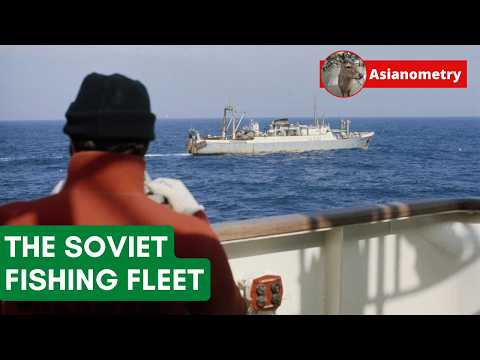
The Soviet Union once commanded the world's largest fishing fleet, which underwent significant industrialization and expansion from the early 20th century until its decline post-Soviet breakup. This blog post explores the fleet's history, its impact on global fisheries, and the environmental consequences of its operations.
The Soviet Union once controlled what was perhaps the world's mightiest fishing fleet. This fleet, akin to a wolf pack of ships, roamed the oceans, fishing extensively and depleting marine life. The second half of the 20th century marked the industrialization of the fishing industry, with the Soviets at the forefront. This article delves into the history of the Soviet fishing fleet, its industrialization, and the consequences of its operations.
The Russian professional fishing industry dates back to at least the early 1800s, primarily focused on inland waterways near major population centers in European Russia. The largest fisheries operated in the Caspian Sea, targeting species such as sturgeon, bream, perch, pike, and carp. Fish were salted and shipped to cities, with the Russian Empire producing about a million metric tons of fish by 1913, predominantly from inland fisheries.
However, the fishing industry faced a collapse during World War I and the subsequent Russian Civil War, with catches plummeting to just 170,000 metric tons by 1919. As the nation began to recover, the Soviet fishing industry shifted focus from traditional inland waters to the vast, untapped oceans. The completion of the Murmansk railroad in 1916 opened access to the rich fishing grounds of the Far East and Northern basins, which were previously unexploited due to their remoteness.
World War II severely disrupted the Soviet fishing trade, resulting in the loss of nearly all motorized vessels and a significant labor shortage as fishermen were drafted into the military. Traditional fishing grounds became battlefields, leading to further declines in production. In response, the Soviet government turned to the Far Eastern and Siberian fishing grounds, significantly increasing catches in these regions.
Post-war, the Soviet Union faced labor shortages and sought to develop its fishing industry as a more efficient alternative to agriculture. The cost of fishing was significantly lower than raising livestock, prompting a push for increased fish production.
In 1946, the Soviets initiated a major expansion of their fishing efforts through the Fourth Soviet Five-Year Plan, aiming for a 57% increase in fishery production by 1950. This plan included the construction of new fishing vessels and the establishment of educational institutions to train a skilled workforce. The focus shifted to high-seas fishing due to the depletion of inland fisheries caused by pollution and industrialization.
The launch of the Fairtry in 1954 marked a turning point in industrial fishing. This revolutionary fishing freezer-trawler was equipped with advanced technologies, allowing for more efficient fishing operations. The Fairtry's design enabled it to stay at sea for extended periods, significantly increasing the volume of fish caught. The success of the Fairtry prompted the Soviets to replicate its design, leading to the construction of similar vessels in the following years.
As the Soviet fleet expanded, the demand for fish began to decline in the post-war era as consumers returned to meat. In response, food companies introduced innovative products like fish sticks, which transformed less desirable fish into popular, easy-to-cook meals. The Soviet government also launched marketing campaigns to promote ocean fish consumption, successfully increasing fish as a protein source for the population.
By the late 1950s, the Soviet Union had developed the world's largest fishing fleet, with over 11,000 extraction vessels. The fleet operated under a military-style command structure, with factory ships serving as motherships for smaller catcher vessels. This centralized control allowed for coordinated fishing operations, utilizing advanced techniques to maximize catches.
As the Soviet fleet expanded its reach, it often encroached on the territorial waters of other nations, leading to tensions with countries like Japan and the United States. The establishment of Exclusive Economic Zones (EEZs) in the 1970s posed a significant challenge for the Soviet fleet, as most of the world's fisheries fell within these zones. The Soviets attempted to negotiate access to these waters through partnerships and joint ventures, but the changing international landscape made fishing increasingly difficult.
The dissolution of the Soviet Union in the early 1990s marked the beginning of the end for the once-mighty fishing fleet. As the country transitioned to a market economy, the centralized control over fisheries was dismantled, leading to the fragmentation of fleets across newly independent states. Many vessels were decommissioned, and the fishing industries faced significant challenges due to reduced capacity and loss of markets.
The legacy of the Soviet fishing fleet is not without its dark chapters. The aggressive whaling program, driven by government quotas, led to the over-exploitation of whale populations. Reports indicate that over 100,000 whales were killed without proper documentation, highlighting the environmental impact of Soviet fishing practices.
The story of the Soviet fishing fleet serves as a cautionary tale about the consequences of industrialized fishing practices. While the Soviet Union may have had the largest and most extensive fishing fleet, similar practices are evident in other countries today, including China, which now dominates global fish catches. The pressures on wild fish populations continue to grow, raising concerns about the sustainability of our oceans. Without significant changes, the future of marine life remains uncertain, with the potential for severe ecological consequences if current trends persist.



















