
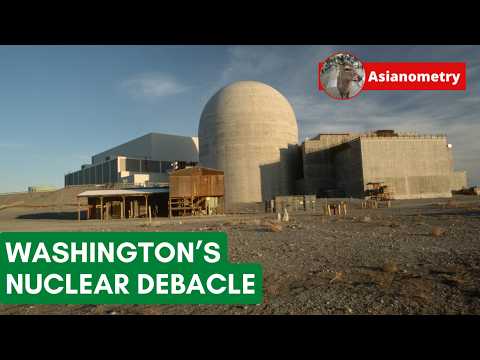
In the 1970s, Washington's attempt to build five nuclear power plants led to the largest municipal bond bankruptcy in U.S. history. This post explores the mismanagement, miscalculations, and eventual fallout of the Washington Public Power Supply System's ambitious nuclear projects, highlighting the lessons learned from this energy debacle.
In the early 1970s, a small agency in Washington state, backed by local utilities, embarked on an ambitious plan to construct five nuclear power plants simultaneously. This endeavor, however, culminated in the largest municipal bond bankruptcy in U.S. history and left four power stations abandoned. The story of the Washington Public Power Supply System (WPPSS) is a complex tale of civil service, poor estimates, nuclear inexperience, and mismanagement, ultimately leading to a significant energy debacle.
Washington state, established in 1889, experienced a population boom due to the Gold Rushes and World War I. This surge created a demand for water and power services, leading to the establishment of utilities in major cities like Seattle and Spokane. While urban residents enjoyed reasonably low rates due to city ownership, rural areas suffered under the high prices of private utilities, prompting the formation of public utility districts (PUDs) to provide community-owned, nonprofit power services.
In the years following their establishment, PUDs began purchasing and reselling power from the federal hydropower system. Washington's mountainous terrain and abundant rainfall made it ideal for hydroelectric power generation. During the Great Depression, the U.S. government funded the construction of dams, leading to the creation of the Bonneville Power Administration (BPA) to distribute this power to local utilities. PUDs managed customer service and daily operations, ensuring that local residents had access to affordable electricity.
By the 1950s, concerns arose regarding the PUDs' heavy reliance on federal power. In response to potential federal cutbacks, seventeen PUDs formed the Washington Public Power Supply System (WPPSS) in 1956, aiming to secure their power generation sources. WPPSS was not a utility but rather an agency authorized to issue nontaxable state bonds to fund projects, including the construction of new dams.
WPPSS initially struggled to find projects, leading to the successful completion of the Packwood Dam in 1964, funded by $13.7 million in bonds. This project marked a significant achievement for the agency, providing a much-needed boost in credibility and financial success.
The story takes a pivotal turn with the Hanford site, established during the Manhattan Project for plutonium production. In 1956, Senator Henry "Scoop" Jackson proposed a dual-purpose reactor at Hanford, which faced opposition but eventually gained traction after the launch of Sputnik. By 1958, the N-reactor was authorized, producing both plutonium and steam for electricity generation.
Flush with success from the Packwood project, WPPSS began exploring nuclear power in 1959. They partnered with the Atomic Energy Commission (AEC) to fund and build an 800-900 megawatt nuclear power plant at Hanford. The project gained Congressional approval in 1962, and despite labor issues, the plant began operation in 1966, quickly becoming the largest civilian nuclear power plant in the U.S.
In the late 1960s, WPPSS and other utilities anticipated a continuous rise in energy demand, leading to the Hydro-Thermal Power Program. This ambitious 20-year plan aimed to construct several large power plants, with WPPSS responsible for three nuclear plants: WNP-1, WNP-2, and WNP-3. The optimism surrounding nuclear energy was palpable, with the belief that it would make power "too cheap to meter."
As construction began, challenges emerged. WNP-2 was relocated due to environmental concerns, and federal budget cuts threatened the viability of existing projects. In response, WPPSS committed to building WNP-1 to replace the aging Hanford reactor. The budget for these projects ballooned from an initial estimate of $500 million to $1.6 billion, straining the agency's resources.
Despite the escalating costs and challenges, WPPSS decided to add two more nuclear reactors, WNP-4 and WNP-5, in response to perceived energy crises. The hope was that building these plants alongside WNP-1 and WNP-3 would yield significant cost savings. However, the reality was far from optimistic, as rising costs and regulatory changes began to take their toll.
The urgency to build five nuclear plants in five years was based on flawed assumptions. The projected energy demand growth was overly optimistic, and the belief that larger nuclear plants would be cheaper proved incorrect. WPPSS struggled with project management, leading to delays, cost overruns, and labor disputes. The organization expanded rapidly but remained ill-equipped to handle the complexities of such large-scale projects.
Labor disputes plagued the construction sites, with strikes and work stoppages becoming common. The contractors and unions struggled to find common ground, exacerbating the delays and increasing costs. By the late 1970s, the estimated costs for the five plants had skyrocketed, with significant portions attributed to labor issues and mismanagement.
The release of the film "China Syndrome" and the Three Mile Island incident in 1979 further damaged public confidence in nuclear energy. Regulatory changes imposed by the Nuclear Regulatory Commission (NRC) added additional layers of oversight, contributing to project delays and cost increases.
By the early 1980s, the estimated cost for completing all five plants had ballooned to $23 billion, prompting WPPSS to halt construction on WNP-4 and WNP-5. The economic recession in Washington state further diminished the justification for completing the projects, leading to widespread layoffs and public outcry.
In January 1982, WNP-4 and WNP-5 were officially canceled, marking the largest municipal bond default in U.S. history at that time. The fallout was significant, with bondholders suing for repayment and utilities facing financial ruin. The Washington Supreme Court ultimately ruled in favor of the utilities, releasing them from obligations to the canceled projects.
The saga of the Washington Public Power Supply System serves as a cautionary tale about the complexities of large-scale energy projects. While WNP-2 eventually opened in 1984, the costs were exorbitant compared to international standards. The agency, later renamed Energy Northwest, has since focused on renewable energy projects, learning from the mistakes of its past. The story of WPPSS is a reminder of the importance of sound management, realistic projections, and the need for thorough planning in the energy sector.



















