
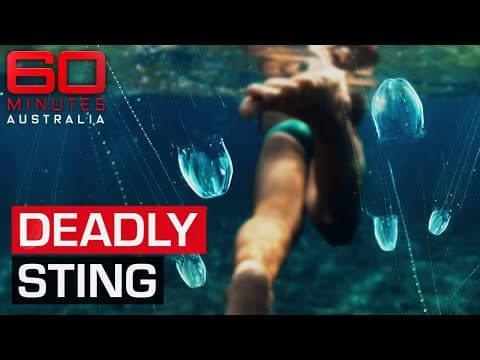
The Irukandji jellyfish, a tiny but deadly creature, is spreading south along Australia's coast due to rising sea temperatures, posing a significant threat to public health and the tourism industry. Experts warn of increasing encounters and severe health risks associated with its stings, which can lead to heart failure and hospitalization.
Australia's tourism industry, a cornerstone of its economy, is facing a significant threat from a tiny yet deadly creature: the Irukandji jellyfish. This small, barely visible jellyfish, often compared to a blue bottle on steroids, has begun to migrate south into more populated areas, raising concerns about public safety and potential economic impacts.
Officially, only two deaths have been attributed to Irukandji stings in Australia, but experts believe the actual number may be higher. As sea temperatures rise, these jellyfish are moving further south, increasing the likelihood of encounters with beachgoers.
Two months ago, communications executive Ay White visited Fitzroy Island to snorkel on the Great Barrier Reef. During her outing, she experienced a tingling sensation across her neck, which she initially dismissed. However, shortly after, she was struck by severe localized pain and began to feel unwell.
Despite wearing a stinger suit, Ay was stung on her exposed neck by an Irukandji jellyfish, which can have tentacles extending nearly a meter. As she struggled to return to shore, she experienced tightness in her chest and difficulty breathing, ultimately leading to her hospitalization. Doctors informed her that she had suffered heart failure due to the sting, and an induced coma was considered.
Professor Jamie Seymour from James Cook University, a leading authority on the Irukandji jellyfish, rates it among the top 10 to 15 venomous animals globally. In Queensland alone, it is estimated that between 250 to 300 people are hospitalized each year due to Irukandji stings, with about 20% requiring intensive care.
Professor Seymour, who has been stung 11 times himself, describes the pain as a wave that escalates uncontrollably. He likens it to a surreal experience where the pain intensifies to levels beyond what one can imagine.
Dr. Theresa KET, a research associate, shared her own harrowing experience, describing the sensation as hot stabbing daggers throughout her body. Her research indicates that the venom affects individuals differently, with some experiencing mild symptoms while others face life-threatening conditions.
Recent laboratory work by Professor Seymour has raised alarms about the effects of Irukandji venom on the heart. In experiments with mice, he observed that the venom caused the heart to lose its ability to pump effectively, leading to cardiac arrest. This unexpected finding highlights the potential severity of Irukandji stings, which could result in more fatalities than previously recognized.
The Irukandji jellyfish's migration southward is a concerning indicator of climate change. As ocean temperatures rise, the jellyfish can survive in previously inhospitable waters, extending their season and range. Professor Seymour warns that the jellyfish could soon reach popular tourist destinations like the Sunshine Coast, posing a significant risk to beachgoers.
In a recent incident, Dr. Clea Ferreira, a Brisbane GP, was stung while swimming at Malula Beach. Despite her medical background, she experienced severe symptoms, including muscle spasms and intense pain. The small mark left by the sting was indicative of an Irukandji encounter, which can often go unnoticed compared to other jellyfish stings that leave more visible marks.
Professor Seymour has long warned about the southern spread of the Irukandji jellyfish, advocating for increased awareness and research to address this growing threat. He emphasizes that ignoring the problem could lead to severe consequences for public health and the tourism industry.
The Irukandji jellyfish represents a significant and growing danger along Australia's coastlines. As climate change continues to alter marine ecosystems, the potential for increased encounters with this deadly creature rises. It is crucial for authorities and the public to recognize the threat and take proactive measures to ensure safety at the beach. The time for action is now, as the Irukandji jellyfish is coming to a beach near you.



















