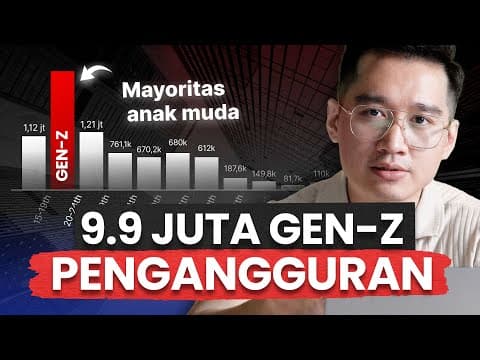
Indonesia faces a significant unemployment crisis among its Gen Z population, driven by issues in national productivity, education, job availability, and the characteristics of the Gen Z workforce. To secure a prosperous future, urgent reforms in education and skill development are necessary.
In recent times, finding a job has become increasingly difficult in Indonesia, particularly for the Gen Z demographic. Recent headlines reveal that 9.9 million Gen Z individuals are currently unemployed, either lacking jobs or not pursuing specific education or training. Initially, one might think this is simply a matter of youth needing time to enter the workforce. However, deeper research indicates that the problem is far more complex and could hinder Indonesia's goal of achieving a prosperous future by 2045.
To understand why Indonesia is lagging behind, we must first examine the country's productivity. A key question arises: why did Apple choose to invest in Vietnam instead of Indonesia? The answer lies in the developmental roadmap that most advanced countries follow, which includes three sectors: agriculture, manufacturing, and services.
Historically, developing nations, including China, began with agriculture, where low-skilled workers were directed towards farming to meet basic needs. Following this, they transitioned to manufacturing, allowing workers to operate machinery and produce goods. Finally, they moved to the service sector, where individuals could add value through services.
Indonesia, however, has experienced premature deindustrialization, moving too quickly from manufacturing to services without adequately developing its manufacturing sector. This has resulted in a significant skills gap, as the demand for high-skilled labor has surged due to globalization and digitalization, while many Indonesian workers remain low-skilled. Consequently, companies like Apple prefer to invest in countries like Vietnam, where the workforce is better prepared.
The second major issue is the state of education in Indonesia. The Secretary-General of the Ministry of Education has stated that higher education is optional, which is concerning given the current job market's demands for high-skilled workers. Only 10% of Indonesians have access to higher education, a stark contrast to countries like the UAE (47%) and Singapore (33%). Despite significant budget allocations for education, the quality and effectiveness of this spending remain questionable.
The concept of return on education is crucial here. For every dollar invested in education, the increase in income for the country should be substantial. Unfortunately, Indonesia's return on education is only around 5%, significantly lower than Vietnam's 9-10%. This indicates that while the budget for education is large, its effectiveness in producing high-skilled labor is lacking.
The third issue revolves around job availability. Indonesia struggles to create jobs at the pace required to accommodate its growing workforce. Over the past 15 years, the formal sector has seen a decline, particularly affecting Gen Z. Historically, a 1% economic growth would create 600,000 new jobs, but now it only generates 200,000.
This decline is exacerbated by the current global economic slowdown, leading many companies to freeze hiring or lay off employees. The cycle of reduced consumption leading to decreased production and, consequently, fewer jobs is a significant concern. The jobs that do exist increasingly require high-skilled labor, which many Gen Z individuals do not possess.
Finally, we must consider the role of Gen Z themselves in this crisis. Surveys indicate that 40% of employers are hesitant to hire Gen Z workers due to perceived traits that make them less adaptable to the workplace. Many Gen Z individuals prioritize mental health and prefer flexible work arrangements, often opting for freelance or part-time positions over traditional full-time jobs.
This preference for informal work can be problematic, especially as the demand for high-skilled labor continues to rise. Gen Z must recognize the urgency of adapting to the current job market and the importance of pursuing education and skills that align with industry needs.
In summary, Indonesia's unemployment crisis among Gen Z is a multifaceted issue rooted in national productivity, education quality, job availability, and the characteristics of the workforce. To secure a prosperous future, it is imperative that reforms in education and skill development are prioritized. Gen Z must embrace the need for higher education and skill acquisition to fill the gaps in the labor market. Only through collective effort can Indonesia hope to achieve its vision of a prosperous future by 2045.