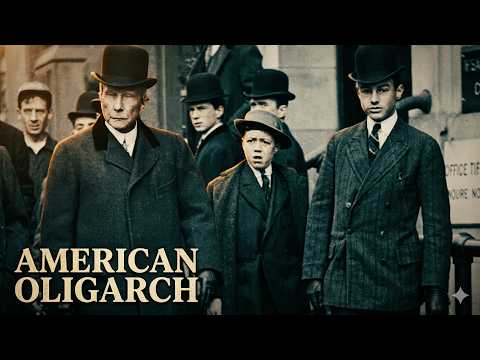
The Rockefeller family, starting from John D. Rockefeller's rise in the oil industry, built one of America's most powerful dynasties. Through ruthless business tactics, philanthropy, and strategic trust management, they influenced global finance, politics, and culture for over a century. Despite controversies, their legacy endures through wealth, institutions, and elite networks like the Trilateral Commission.
The Rockefeller family stands as one of the most powerful and influential dynasties in modern America. From controlling 90% of the country's oil supplies to quietly steering global finance through Chase Bank and elite networks like the Trilateral Commission, their impact has been profound and lasting.
America in 1839 was a nation on the edge, recovering from the Panic of 1837. John D. Rockefeller was born into this challenging environment. His father, William Avery Rockefeller, known as Devil Bill, was a traveling salesman who sold fake cancer cures and was notorious for cheating customers and even his own family. His mother, Eliza, was a devout Baptist who instilled discipline, thrift, and religious piety in her children.
From a young age, John D. Rockefeller was serious and business-minded. At 12, he lent money at interest, and by 16, he worked as a clerk in Cleveland, already dreaming of something bigger than a desk job.
At 19, Rockefeller partnered with Maurice Clark and George Gardner to form Clark, Gardner and Company, a commission house dealing in grain and other goods. The American Civil War created a massive demand for supplies, and their profits soared as they supplied the Union Army.
Rockefeller viewed the war not as a moral crusade but as a market opportunity, seizing it with methodical precision.
In 1859, Edwin Drake drilled the first commercial oil well in Pennsylvania, sparking an oil rush. Rockefeller saw the chaotic drilling industry as wasteful and unpredictable but recognized refining as the key to controlling the industry.
In 1863, he partnered with chemists Samuel Andrews and Maurice Clark to build a refinery in Cleveland, producing high-quality kerosene at scale. Despite fierce competition and price crashes, Rockefeller sought a permanent edge.
By 1871, the oil industry was in turmoil with overproduction and collapsing prices. Rockefeller and railroad executives formed the South Improvement Company, a secret deal granting Rockefeller and allies huge shipping rebates, crushing competitors.
Using this advantage, Rockefeller bought out 22 of 26 Cleveland refiners in six weeks, consolidating near-total control of Cleveland refining. This event, known as the Cleveland Massacre, led to the incorporation of Standard Oil of Ohio in 1870.
By the late 1870s, Standard Oil controlled 90% of American oil refining.
Ida Tarbell, daughter of a crushed competitor, exposed Standard Oil's ruthless tactics in a 19-part series. Her meticulous work humanized victims and revealed Rockefeller's monopoly as predatory rather than progressive.
Public outrage grew, cartoons depicted Rockefeller as an octopus strangling the country, and politicians called for action.
The Sherman Antitrust Act of 1890 aimed to curb monopolies. In 1906, the Justice Department sued Standard Oil. After years of litigation, the Supreme Court ruled in 1911 that Standard Oil was an illegal monopoly and ordered its breakup into 34 companies.
Ironically, this breakup made Rockefeller richer, as shareholders received stock in the new companies, which soared in value. By 1913, Rockefeller became the world's first billionaire.
John D. Rockefeller Jr., born in 1874, grew up under strict moral discipline. He joined the family business and married Abby Aldridge, bringing culture and political connections.
The family name was tarnished by public backlash, and Junior vowed to redeem it.
In 1913, a coal miners' strike at Colorado Fuel and Iron, partly owned by Rockefeller interests, led to the Ludlow Massacre where National Guard troops attacked striking workers, killing 21.
Junior responded by engaging directly with workers, improving conditions, and pioneering modern corporate public relations, transforming the family's image.
Junior invested millions in education, public health, conservation, and cultural projects like restoring Colonial Williamsburg and developing Rockefeller Center in New York during the Great Depression, creating jobs and revitalizing the city.
He professionalized philanthropy, building large foundations with clear goals and measurable results, setting a model still followed today.
In the 1920s and 1930s, the Rockefeller Foundation funded eugenics research in Germany, supporting institutes that influenced Nazi racial policies and forced sterilizations.
Standard Oil successors partnered with German conglomerates like IG Farben, exchanging patents and supporting the Nazi war effort, including production of Zyklon B gas used in concentration camps.
These dark chapters have cast long shadows over the family's legacy.
After World War II, the Rockefeller Foundation played a central role in global reconstruction, funding health, education, and agriculture programs worldwide.
John D. Rockefeller Jr. expanded grants, helped purchase land for the United Nations headquarters, and turned philanthropy into a global engine of influence.
Born in 1908, Nelson was ambitious and charismatic, aspiring to the presidency. He served in various government roles, became Governor of New York, and ran for president three times but never secured the nomination.
His tenure included the controversial handling of the 1971 Attica prison uprising, which resulted in a deadly assault and damaged his reputation.
Born in 1915, David was quiet, methodical, and intellectually curious. He rose to become chairman and CEO of Chase Manhattan Bank, expanding its global reach.
He formed a powerful alliance with Henry Kissinger, sharing a vision of elite coordination for global stability.
In 1973, David founded the Trilateral Commission, a private group of influential businessmen and politicians from North America, Europe, and Asia, shaping global trade, energy, and security policies.
The Rockefeller family remains one of America's wealthiest dynasties, with a collective net worth around $10 billion spread across over 200 descendants.
Their foundations manage billions, funding global health, climate initiatives, and environmental causes.
The family maintains board seats in major institutions and influences international policy and sustainable development.
John D. Rockefeller Sr. established irrevocable trusts in 1934 to protect the family's wealth from estate taxes and ensure its longevity.
These trusts, layered and professionally managed, provide steady income and protect assets from lawsuits and mismanagement, enabling the family to remain cohesive and wealthy over seven generations.
From a poor boy in 19th-century America to a global dynasty shaping politics, economy, and culture, the Rockefellers have left an indelible mark on history.
Their story is one of ruthless business acumen, strategic philanthropy, public controversy, and enduring influence.
While their legacy includes both remarkable achievements and dark chapters, the Rockefeller family remains a formidable force in America and the world.
Their ability to adapt, manage wealth, and wield influence continues to fascinate and impact generations.
This comprehensive history of the Rockefeller dynasty reveals the complexities of power, wealth, and legacy in modern America.