
This blog post explores the biblical account of Jesus casting demons into a herd of pigs, examining the historical context, geographical discrepancies, and the deeper implications of this event for contemporary believers.
In a striking biblical narrative, Jesus encounters a man possessed by demons and casts these demons into a herd of pigs, which then rush down a hill and drown in a lake. This event, found in the Gospel of Mark, raises significant questions and concerns that merit deeper exploration.
To understand why Jesus kills the pigs, we must first examine the circumstances surrounding his encounter with the demon-possessed man. Following a miraculous calming of a storm on the Sea of Galilee, Jesus and his disciples travel to the region of the Gines. However, this location presents a geographical puzzle, as Gasa, identified as the region of the Gines, is not situated near any significant body of water. The nearest water source, the Jabbok River, is several miles away, leading to confusion regarding the accuracy of Mark's account.
Utilizing biblical study tools, such as Logos Bible Software, reveals that some manuscripts do not mention Gasa as the location. Instead, they refer to the regions of the Gines and Gadara. A closer examination of maps indicates that Gasa is indeed the most plausible location, as it is adjacent to Lake Gennesaret, also known as the Sea of Galilee. This detail is crucial, as the geographical context is tied to the events that unfold.
When Jesus meets the demon-possessed man, he asks the demon for its name. In the cultural context of the time, names held significant meaning, often reflecting authority and identity. The demon responds, identifying itself as "Legion," indicating a multitude of demons within the man. This term not only suggests a large number of demons but also alludes to the Roman Legion, specifically the 10th Roman Legion, which was stationed in the region. This historical reference would resonate deeply with Mark's original audience, who viewed the Roman presence as an oppressive force.
Mark's narrative includes a detail about pigs grazing on the hillside, which would have captured the attention of his audience for two primary reasons. First, pigs were considered unclean animals according to Jewish law, making their presence in the story significant. Second, the 10th Roman Legion's standard featured a pig, symbolizing the oppression and paganism that the Jewish people faced. Thus, Jesus's presence among the pigs signifies a confrontation with the very forces that oppressed the Jewish people.
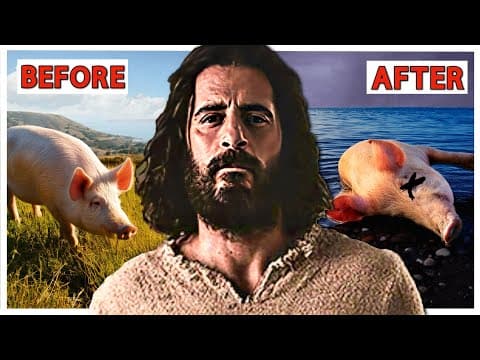
As the story progresses, the demons beg Jesus to allow them to enter the herd of pigs, and he grants their request. The pigs, numbering around 2,000, then rush down a steep embankment into the Sea of Galilee and drown. This detail is not merely incidental; it carries profound implications. The number of pigs parallels the size of a Roman battalion, suggesting that Jesus is demonstrating his authority over the oppressive forces represented by the Roman Legion.
By allowing the demons to enter the pigs and subsequently causing their demise, Jesus is making a powerful statement. He is asserting his ability to drive out the forces of oppression from the land. For the Jewish people, who viewed Rome as the enemy, this act would have been both shocking and hopeful. Jesus is not just confronting a spiritual battle; he is symbolically challenging the political and cultural dominance of Rome.
The implications of this story extend beyond its historical context. Today, we live in a culture that seeks to define us, influencing our choices, beliefs, and values. Many individuals find themselves inadvertently conforming to societal norms that may not align with the teachings of Jesus. This narrative serves as a reminder that we must be vigilant about where we place our allegiance and whom we allow to influence our lives.
Jesus's actions in this story draw a clear line in the sand: it is either allegiance to him or to the oppressive forces of the world. He emphasizes that there is no room for competing authorities in our lives. As believers, we are called to recognize the dangers of devoting our hearts to anything or anyone other than Jesus, especially when we may not even realize it is happening.
The story of Jesus and the pigs is not just a curious biblical account; it is a profound lesson about authority, oppression, and the choices we make in our lives. Jesus's confrontation with the demons and the pigs serves as a powerful reminder of his sovereignty and the importance of remaining faithful to him in a world filled with competing influences. As we reflect on this narrative, we are encouraged to examine our own lives and ensure that our hearts remain aligned with our true Savior.



















