
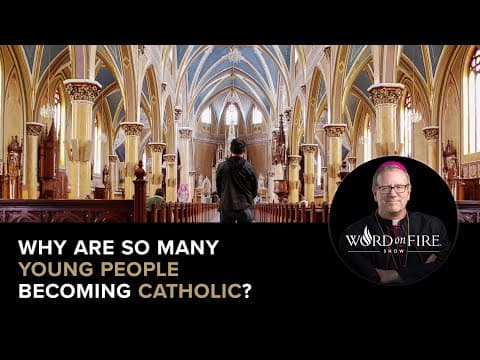
Recent trends show a significant increase in young people converting to Catholicism, challenging the narrative of religious decline. Factors include a search for meaning, dissatisfaction with secularism, and a desire for tradition and community. This blog explores the reasons behind this resurgence and the implications for the Church.
Welcome back to the Word on Fire Show. I'm Matthew Petrusk, senior director of the Word on Fire Institute and the host of the Word on Fire Show. Thank you for joining us. For decades, decline and disaffiliation have been dominating the narrative about religion in general and Catholicism in particular in the United States and throughout the West. The data has been clear: people, especially young people, have been leaving the pews in droves and presumably never coming back. However, something seems to have changed.
As many media outlets, including secular ones, have reported recently, both interest in and conversion to the Catholic Church has been surging, particularly among young adults. While secularism still dominates the culture, especially in business, entertainment, and politics, the once common wisdom that an increasingly secular society would lead to the death of Christianity is being challenged.
Recent statistics highlight this trend. According to a New York Post article titled "Young People Are Converting to Catholicism en Masse," some dioceses are reporting year-over-year increases of 30 to 70% in recent years. Additionally, a Harvard survey cited by Fox News indicates that the number of Generation Z individuals identifying as Catholics increased by 6% in just one year. This is significant and outside the margin of error.
To discuss this apparent religious revival, we welcomed Bishop Robert Barron, who has been on the front lines of evangelization for over 25 years. He expressed delight at the resurgence, noting that when he began his ministry, the environment was combative, filled with negative feelings about religion. However, he believes that the bleak worldview propagated by new atheists has not resonated with young people, who are now seeking deeper meaning and purpose in life.
Bishop Barron argues that the deep confusion and sadness measured in surveys of young people—rising rates of depression, anxiety, and suicide—have led many to seek sources of meaning and purpose. As they turn to religion, they often find themselves online, discovering communities and discussions about faith that resonate with their search for truth.
One notable aspect of this resurgence is the centrality of men in the interest in Catholicism. Bishop Barron suggests that men have been under-challenged in the Church for a long time. Many young men are responding positively to the moral and spiritual challenges presented by Catholicism, which calls for a heroic life and real sanctity rather than spiritual mediocrity.
Interestingly, while the common narrative suggests that COVID-19 was detrimental to religiosity, there is evidence that the collective response to the pandemic may have sparked a renewed interest in faith. The isolation experienced during lockdowns may have led many to seek connection, and religion offers a profound sense of community and belonging.
Another factor contributing to the resurgence is the backlash against progressive ideologies, often referred to as wokeism. Bishop Barron argues that this ideology creates division and conflict, whereas religion, particularly Catholicism, promotes unity and community. As young people become disillusioned with the divisive nature of wokeism, they may find solace in the teachings of the Church, which emphasize love and connection.
Young people today are also showing a desire for tradition, which contrasts with the typical narrative that they reject it. Bishop Barron explains that tradition represents an accumulation of objective values preserved over time. As young people rebel against contemporary norms, they are drawn to the stability and depth that tradition offers.
The liturgy, particularly more reverent and pious forms of worship, is also appealing to young people. Bishop Barron notes that these forms of worship awaken a sense of the transcendent and the mystical, which many young people are longing for in a world that often feels spiritually barren. The aesthetic and ritualistic elements of traditional liturgy resonate deeply, providing a connection to something greater than themselves.
Despite the positive trends, it is essential to remain realistic about the challenges facing the Church. Bishop Barron cautions against becoming overly optimistic, as the Church has lost significant ground in cultural influence and attendance. The aggressive secularist culture and the culture of self-invention continue to pose significant challenges.
Bishop Barron is also concerned about the increasing attacks on religious freedom, both domestically and globally. He highlights the alarming rise in attacks on Catholic churches and individuals, which have increased by 700% since 2018. This trend reflects a broader cultural hostility towards Christianity, which must be addressed.
In conclusion, the resurgence of interest in Catholicism among young people is a complex phenomenon driven by a search for meaning, a reaction against secularism and wokeism, and a desire for tradition and community. While there are significant challenges ahead, the Church has an opportunity to engage with this new generation and provide the spiritual guidance they seek. As we move forward, it is crucial to remain vigilant and proactive in evangelization efforts, ensuring that the Church is present and accessible to those who are searching for truth and connection.



















