
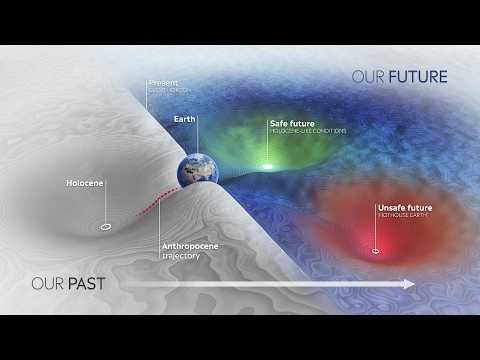
Climate scientists warn that the planet is changing faster than expected, with significant risks of crossing tipping points that could lead to catastrophic climate outcomes. Current trends indicate a potential rise in global temperatures that could have devastating economic and ecological impacts. Immediate action is necessary to mitigate these risks and transition towards sustainable practices.
Climate scientists are increasingly alarmed by the rapid changes occurring on our planet. Despite years of warnings, the reality is that we are facing risks that have been underestimated. Abrupt changes are happening at a pace that exceeds scientific expectations, prompting urgent discussions about our future.
Fifteen years ago, the planetary boundary framework was introduced, outlining nine Earth system processes essential for maintaining stability and resilience on Earth. This framework serves as a scientific basis for understanding the limits within which humanity can safely operate. A decade ago, the world committed to the Paris Climate Agreement, and now, as we navigate through this decisive decade, it is crucial to assess where we stand.
As of now, we have reached a global mean surface temperature rise of 1.2 degrees Celsius, marking the warmest temperatures on Earth in the past 100,000 years. In 2023, we are nearing an annual mean of 1.5 degrees Celsius. The acceleration of warming is particularly concerning; from 1970 to 2010, the increase was 0.18 degrees Celsius per decade, but since 2014, it has jumped to 0.26 degrees Celsius per decade. If this trend continues, we could exceed 2 degrees Celsius within 20 years and reach 3 degrees Celsius by 2100, leading to disastrous consequences driven by human activity.
The data shows a linear change until the 1950s, followed by what is termed the "great acceleration." This phenomenon is evident across various parameters critical to human well-being, including overconsumption of freshwater, the sixth mass extinction of species, and pollution of freshwater systems with nitrogen and phosphorus. These changes are undermining the stability of our planet and are already impacting economies worldwide.
The consequences of climate change are manifesting in severe economic costs and human suffering. In 2023 alone, climate-related disasters have resulted in up to 12,000 deaths and incurred costs of approximately 200 billion US dollars in the United States. Scientific assessments indicate that if current trends continue, we could face an 18 percent loss of global GDP by 2050, equating to a staggering 38 trillion US dollars annually.
One of the critical issues at hand is the buffering capacity of the Earth system, which refers to its ability to absorb shocks and stressors. Currently, intact natural systems have absorbed 53 percent of carbon dioxide emissions from fossil fuels and land use changes. However, evidence suggests that these systems are beginning to fail. For instance, the boreal forests and parts of the Amazon rainforest are losing their capacity to act as carbon sinks.
The ocean, which absorbs 90 percent of the heat from climate change, is also showing signs of distress. Recent data indicates a significant spike in sea surface temperatures, raising concerns about the ocean's resilience and its potential to release heat back into the atmosphere, further exacerbating warming.
We are at a critical juncture where we must consider whether we are pushing the planet beyond its stability thresholds. Crossing tipping points in major systems, such as the Greenland ice sheet and the Amazon rainforest, could lead to irreversible changes that amplify warming. Scientific assessments have identified 16 tipping element systems, with five of these at risk of tipping at just 1.5 degrees Celsius of warming.
To avoid catastrophic outcomes, we must adhere to the guidelines set forth by the Intergovernmental Panel on Climate Change (IPCC). This includes operating within a global carbon budget that allows for a 50 percent chance of limiting warming to 1.5 degrees Celsius. Currently, we have only 200 billion tons of carbon dioxide left to emit to stay within this limit, which translates to a mere five years at current emission rates.
Immediate action is required to reduce emissions by at least seven percent annually and achieve net-zero emissions by 2050. Even with these efforts, we may still experience a temporary overshoot of the 1.5-degree limit, necessitating a period of recovery.
The urgency of the situation calls for exponential change rather than linear progress. We must recognize our interconnectedness and govern the planet collectively. Solutions are available, including a rapid transition away from fossil fuels, the adoption of circular business models, and the promotion of sustainable food systems.
Despite the daunting challenges ahead, there is hope. A significant portion of the global population is concerned about climate change and supports scientific solutions. Implementing these solutions not only addresses the climate crisis but also fosters healthier, more stable economies. The time to act is now, as the future of our planet and generations to come hangs in the balance.



















