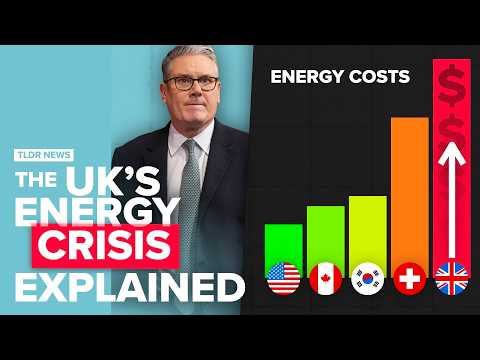
The UK faces one of the highest electricity prices globally, driven by a flawed marginal pricing system, heavy reliance on gas, and grid limitations. This crisis has hurt the economy, increased inflation, and slowed decarbonization efforts. Despite these challenges, the UK’s efficient energy use relative to GDP offers hope for future economic growth with improved energy availability.
If you ask the average Brit what’s gone wrong in the UK, common answers might include high taxes, ongoing NHS crises, the cost of living, or student loans. However, few would immediately point to energy, despite the UK currently suffering from some of the highest energy prices in the world. This energy crisis has a profound and often overlooked impact on the broader economy. In this article, we explore how the UK arrived at this situation, why it matters, and why there might still be hope on the horizon.
Energy consumption can generally be divided into two categories:
The UK performs reasonably well in terms of direct fuel consumption. For example, petrol prices and industrial gas prices in the UK are broadly comparable to those in other European countries. However, the real problem lies in electricity prices, which are extraordinarily high.
According to UK government data, electricity costs for industrial users stand at 27 pence per kilowatt-hour, the highest in the developed world by a significant margin. Domestic users pay around 30 pence per kilowatt-hour, second only to Germany. This was not always the case; as recently as the early 2010s, UK electricity prices were similar to those in other countries.
The consequences of these high electricity prices are severe:
A key factor often blamed for high electricity prices is the UK’s marginal pricing system. Here’s how it works:
This system made sense when most electricity came from fossil fuels with similar costs. However, today’s electricity generation is more diverse, including solar and wind, which have much lower costs.
For example, if solar generators bid 5 pence per kilowatt-hour and gas generators bid 20 pence, but demand exceeds solar capacity, the wholesale price is set at 20 pence, even though the average cost is lower.
Because renewable sources like solar and wind rarely meet total demand, gas generators often set the wholesale price. A 2023 UCL paper found that between 2015 and 2021, gas set the wholesale price 98% of the time in the UK, more than any other European country.
This reliance makes the UK electricity market highly vulnerable to international gas price fluctuations, as seen after Russia’s invasion of Ukraine. Wholesale electricity prices have closely tracked international gas prices in recent years.
Other European countries such as Italy, the Netherlands, Belgium, and Greece also rely heavily on gas (at least 80% of the time) but enjoy significantly lower electricity prices than the UK.
This discrepancy points to deeper issues with the UK’s energy market beyond just gas reliance.
Another problem lies in the UK’s electricity grid and how the marginal pricing system handles geographical constraints:
This issue was less problematic decades ago when coal and gas plants were more evenly distributed. However, as renewables grow and the grid ages, balancing costs are expected to quadruple between 2022 and 2026.
The UK’s heavy reliance on gas stems from a lack of easy alternatives:
These factors combine to limit the UK’s ability to diversify away from gas quickly.
Despite these challenges, there is a remarkable positive aspect:
This means that with even slightly more plentiful and affordable energy, the UK could become one of the richest countries in the world.
The UK’s energy crisis is a complex issue involving a flawed marginal pricing system, heavy dependence on gas, grid infrastructure limitations, and regulatory challenges. These factors have led to some of the highest electricity prices globally, with significant economic consequences.
However, the UK’s efficient use of energy relative to its economic output offers hope. Addressing the structural problems in the energy market and investing in infrastructure and alternative energy sources could unlock substantial economic growth and help the UK transition to a more sustainable energy future.
Understanding these dynamics is crucial for policymakers, businesses, and citizens as the UK navigates this critical challenge.