
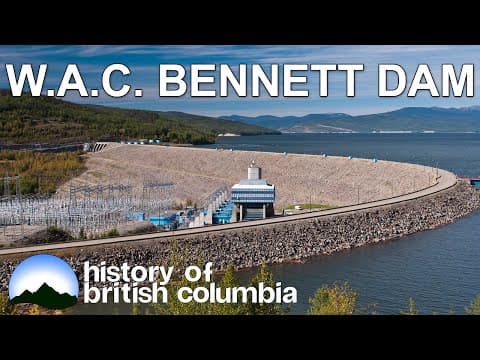
The WAC Bennett Dam, one of the largest earthfill dams globally, transformed British Columbia's energy landscape. Built in the 1960s, it harnessed the Peace River's potential, creating Williston Lake and the Gordon M Shrum Generating Station, which together support the province's renewable energy needs and economic growth while impacting local ecosystems and Indigenous communities.
The WAC Bennett Dam, located on the Peace River in Northern British Columbia, stands as one of the largest earthfill dams in the world. Its construction was pivotal in the industrialization and economic development of British Columbia, particularly through the creation of the Williston Lake Reservoir and the Gordon M Shrum Generating Station.
The journey of electricity generation in British Columbia began in the 19th century with the British Columbia Electric Railway, which initially powered streetcars and lighting through coal-fired steam plants. As the demand for electricity grew, particularly with the advent of sawmills and factories converting to electric power, BC Electric was tasked with developing hydroelectric projects to meet this burgeoning need.
Key projects such as the Bunson Lake (completed in 1903) and Stave Lake (completed in 1912) were among the first to supply power for the expanding interurban and streetcar systems. By the early 1950s, British Columbia was experiencing rapid population growth and industrial expansion, leading to an increased demand for electrical power.
Premier WAC Bennett recognized the untapped hydroelectric potential of the Peace River as a means to meet the province's energy demands and foster economic development, especially in Northern and rural areas. His government developed a comprehensive energy strategy known as the Two Rivers Policy, which aimed to harness electrical power from the Peace River and the Columbia River.
The Two Rivers Policy was an ambitious plan to utilize the immense water flow of both rivers to generate clean, renewable energy. This strategy not only aimed to secure British Columbia's energy future but also sought to reduce reliance on fossil fuels and generate revenue by selling excess power to other regions, including the United States.
The Peace River Project, the first major outcome of the Two Rivers Policy, began construction in 1961, initially referred to as the Portage Mountain Dam. This monumental undertaking took six years to complete, costing approximately $750 million (equivalent to about $5.5 billion today).
Constructed under the ownership of the newly formed BC Hydro, the dam involved blasting three massive concrete-lined tunnels through a canyon wall to divert the river. A low coffer dam was built to direct the water into these tunnels, allowing construction to proceed on a dry riverbed. A second coffer dam was also necessary to manage rising spring waters, measuring 1,100 feet across and 130 feet high.
The dam required over 100 million cubic yards of material, making it one of the largest projects of its kind. A continuous conveyor belt, the largest at the time, transported graded material to the site, moving at 20 km/h and powered by 4,850 horsepower motors.
Thousands of workers were involved in the project, necessitating the construction of infrastructure such as roads and housing for workers. The dam was completed in the fall of 1967, with the first generators coming online in 1968. Although the project was completed on time and on budget, additional construction continued through the 1970s, culminating in the installation of the last generator in 1980.
Upon completion, the dam was renamed the WAC Bennett Dam in honor of the premier who played a crucial role in its development. The dam created Williston Lake, named after Bennett's trusted cabinet colleague Ray Williston. This reservoir is the largest in British Columbia and one of the largest globally, covering an area of 1,760 square kilometers and taking five years to fill.
The creation of Williston Lake required flooding a vast area, significantly impacting local ecosystems and Indigenous communities. The flooding disrupted habitats and displaced wildlife populations, while Indigenous communities, particularly the Sikini Nation, faced severe consequences as large portions of their traditional lands were submerged, forcing them to relocate and adapt to the loss of access to vital hunting, fishing, and gathering areas.
Integral to the WAC Bennett Dam is the Gordon M Shrum Generating Station, named after a prominent physicist and engineer who contributed significantly to British Columbia's hydroelectric development. Shrum was appointed by WAC Bennett to oversee the construction of the Peace River Project.
The Gordon M Shrum Generating Station is one of Canada's largest hydroelectric generating stations, located at the base of the WAC Bennett Dam. It utilizes water from Williston Lake to generate over 2,700 megawatts of power, supplying about one-third of British Columbia's total electricity needs. The station houses ten generating units that harness the power of the water flowing through the dam to produce electricity.
The WAC Bennett Dam, the Gordon M Shrum Generating Station, and the Two Rivers Policy remain critical components of British Columbia's energy infrastructure. They have enabled the province to become a leader in renewable energy production, with hydroelectric power constituting a significant portion of its electricity supply. The legacy of the WAC Bennett Dam is not only one of engineering achievement but also a reminder of the complex interplay between energy development and environmental stewardship.



















