
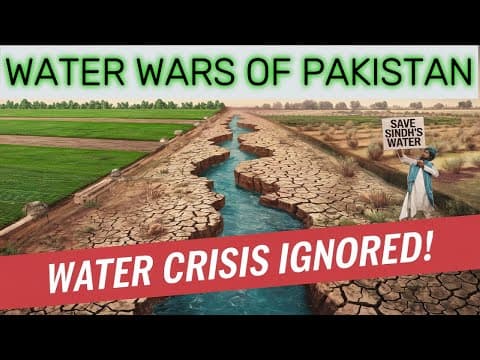
The Green Pakistan Initiative aims to address environmental challenges but faces backlash due to potential water diversion from Sindh, threatening agriculture and livelihoods. Protests highlight historical grievances and demand adherence to the 1991 water Accord, as Sindh grapples with severe water shortages and mismanagement.
In recent months, Sindh has witnessed significant protests against the Green Pakistan Initiative, a project aimed at addressing environmental and agricultural challenges in the region. Despite the scale of these protests, they have received minimal media coverage, highlighting the complexities of issue-based politics in Pakistan. This blog post delves into the details of the Green Pakistan Initiative, the protests it has sparked, and the broader implications for Sindh's water crisis.
The Green Pakistan Initiative is a bold project with a budget of 21 billion rupees, designed to construct six new canals on the Indus River. The primary goal is to divert water upstream to irrigate the Cholistan Desert in South Punjab, promoting corporate farming and agricultural growth. While the initiative promises economic prosperity, it raises serious concerns about environmental sustainability and the livelihoods of millions in Sindh.
The initiative aims to transform barren lands into fertile grounds, fostering ecological balance and economic growth. However, experts warn that the diversion of water could lead to irreversible environmental damage, particularly affecting the agricultural landscape of Sindh, where nearly 60 million people reside.
The protests against the Green Pakistan Initiative have been organized by various political and social groups, including the Awami Tariq, the Grand Democratic Alliance, and the Sindh Taraqqi Pasand Party. These protests have been ongoing for several months, with thousands gathering in different cities to voice their concerns.
Protesters argue that the proposed canals threaten their survival, echoing historical struggles against similar projects. They fear that the new canals, particularly the Chashma-Jum link canal and the Taunsa-Panjnad canal, will divert essential water resources from Sindh to Punjab, leading to barren lands and severe food shortages in a region already grappling with poverty.
At the heart of the protests is the demand for strict adherence to the 1991 Water Accord, which was established to ensure fair distribution of water among Pakistan's provinces. The Accord allocated water as follows:
Since the Accord's implementation, Sindh's share of water has drastically decreased from approximately 75% to around 40%. Currently, Sindh faces an annual water shortage of 45%, receiving nearly half of what was originally allocated. This decline has severely impacted Sindh's agricultural sector, which relies heavily on the Indus River for irrigation.
The current water crisis in Sindh is not a recent development; it is the result of decades of mismanagement and poor policy decisions. The roots of this crisis can be traced back to British colonial policies that prioritized resource exploitation and cash crop production.
The British constructed irrigation canals post-1857 to expand agricultural production, leading to the creation of a new landowning class that controlled water access. The construction of the Sukkur Barrage in 1932 further disrupted natural water channels and displaced local communities, exacerbating inequalities in water distribution.
After Pakistan's independence in 1947, the trend of expanding canal systems continued, with 18 additional barrages built between 1960 and 1990. While these developments initially boosted agricultural output, they also led to long-term issues such as unequal water distribution and environmental degradation.
Today, Sindh's rural population, with 37% living below the poverty line, relies on agriculture for survival. However, due to severe water shortages, nearly 18 million acres of cultivable land remain barren. The new canal project threatens to worsen this situation, potentially rendering an additional 12 million acres infertile.
Farmers and activists argue that instead of constructing new canals, the government should focus on increasing water storage capacity, as promised in the 1991 Accord. However, authorities have opted to alter existing water channels, further complicating the crisis.
The protests against the Green Pakistan Initiative underscore deep-rooted structural inequalities and mismanagement in Pakistan's water governance. If these issues are not addressed, the consequences will be devastating not only for Sindh but for the entire country. The situation calls for urgent attention to ensure equitable resource distribution and sustainable management of water resources to safeguard the livelihoods of millions.



















