
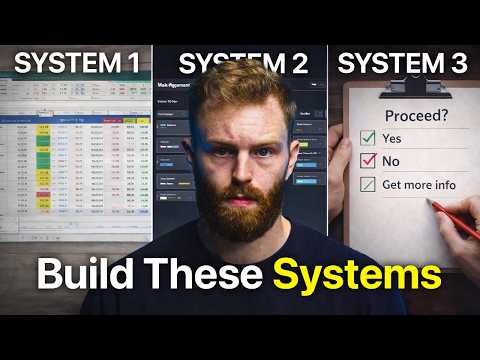
Many entrepreneurs feel trapped working long hours because their business depends entirely on their involvement. By implementing three key systems—a scorecard system for tracking performance, a simple task management system, and a decision-making system—you can create a business that runs and scales without you. These systems provide visibility, accountability, and autonomy to your team, enabling growth while reducing your workload.
Do you ever feel trapped in your business? Like the moment you stop working, the business stops working? This is a common experience for many entrepreneurs who believe that constant involvement is just how business works. As a result, they end up working 80 hours a week without seeing the growth they desire.
However, after working with over 100 business owners, it turns out that you only need three specific systems to have your business run and scale without you. This article will explore these three systems and how to build them so your business doesn’t fall apart when you step away, allowing you to scale faster while working less.
The first and most important system is the scorecard system. Without it, you are forced to manage your business by guessing, stressing, and wondering what to do next.
For your business to run without you, two things must be true:
The way to achieve this is through data, which you track in a scorecard system.
Map Out Your Business Systems: Identify the core functions of your business, typically marketing, sales, operations, and finance. Larger businesses may also include HR.
Identify Goal Outputs: For each function, determine the goal outputs such as generating leads, converting leads into customers, delivering products or services, and managing cash flow and profitability.
List Every Task: Write down every task done in your business and identify the goal of each task. Tasks naturally align with business functions.
Create Scorecards: Each system gets its own simple scorecard. Use tools like Google Sheets to create a spreadsheet for each system with tabs for each month and dates down the left side.
Track Metrics: For each task, determine metrics to track performance. Typically, track an input metric (volume) and an output or conversion metric (performance quality).
Assign Responsibility: Have team members responsible for each process fill out the data.
Set KPI Standards: Establish goals for each metric. Metrics below the goal indicate problems that need fixing.
In systems, the theory of constraints states that only one thing limits the system’s throughput and output. Focus on fixing the metric furthest below its goal earliest in the system before moving on to the next.
With this system, your team can self-manage and improve without your constant involvement, while you maintain oversight and intervene only when necessary.
Even with a scorecard system, if you are the one moving tasks forward, your business will never run itself. The second system is a task management system that allows your team to work without you assigning, chasing, or clarifying everything.
Most task management software is overly complex, which increases friction and reduces adherence. Your system should be as simple as possible.
Actionable Outcome: Tasks should be specific and completable in under two hours. For example, instead of "build website," use "draft 10 headline variations for sales page and choose one."
Deadline: Every task needs a deadline to prioritize work effectively. Tasks with the closest deadlines get priority.
Responsible Person: Assign someone responsible for completing the task to a high standard and ensuring it gets done.
Clear Workflow: For recurring tasks, have a Standard Operating Procedure (SOP) document. For one-off tasks, have a handoff procedure explaining how work moves to the next step.
Create a list ordered by deadlines so team members know what to do first and next, removing decision fatigue and procrastination.
This system should exist at both individual and company levels for accountability and smooth handoffs, ensuring tasks get done on time and to a high standard without micromanagement.
Decisions often bottleneck through the owner, causing overload and slowing progress. The third system is a decision system that pre-decides who makes decisions, under what rules, and based on what data.
Decision Classification: Determine which decisions you want to make and which you want to delegate. Use a quadrant framework:
Decision Ownership: Assign decision-making responsibility based on team roles. For example, sales decisions go to the sales manager, small refund decisions to operations.
Rules and Constraints: Define rules for decisions to prevent wrong choices, such as budget limits or customer experience priorities.
Feedback Loop: Employees learn from decisions over time. When a bad decision is made, explain why and how to improve. Use data from scorecards to evaluate decisions.
When team members bring decisions to you, use the "one free one" rule: they present one problem, three solutions, and one recommendation. You then coach them on their choice, helping them improve future decisions.
By implementing these three systems—a scorecard system for data-driven visibility, a simple task management system for clear accountability, and a decision system for efficient delegation—you can build a business that runs and scales without relying on you. This approach reduces your workload, empowers your team, and accelerates growth.
If you want to learn more about utilizing data to scale your business without it relying on you, consider exploring further resources on the theory of constraints and decision-making frameworks.



















