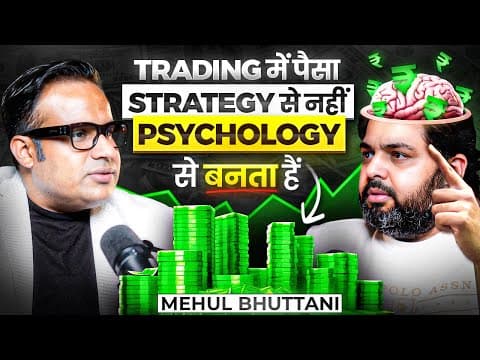
In a detailed discussion on trading psychology, Mehul Bhuttani emphasizes the importance of understanding market psychology, liquidity, and risk management over mere chart patterns. He highlights that 93% of traders lose due to common mistakes like poor discipline, overtrading, and ignoring stop losses. Consistency, emotional control, and proper position sizing are essential for long-term success in trading.
Trading is often seen as a quick way to make money, but the reality is far more complex. In a comprehensive discussion on the Sagar Sinha Podcast, Mehul Bhuttani, a seasoned trader and mentor, sheds light on the critical aspects of trading psychology, discipline, and risk management that every trader must understand to succeed.
Many traders get motivated by seeing others' profit and loss (PNL) statements and aspire to make quick profits. However, Mehul questions whether motivation is more important than consistency. He stresses that consistency in trading is far more crucial than short bursts of motivation.
Traders are often taught to buy at support levels and sell at resistance levels based on price rejections. Mehul explains that this conventional wisdom is incomplete. Just because the price has bounced off a support level once or twice does not guarantee it will hold again. The sustainability of support or resistance levels depends on the underlying psychology of buyers and sellers.
He points out that if many buyers are active at a support level but the price does not rise, it indicates sellers are also present, possibly triggering stop-loss orders below support. Smart money often exploits these stop-loss orders to buy at better prices. Understanding this psychology behind support and resistance is vital.
According to Mehul, 95% of the trading volume is controlled by big players or smart money. These players manipulate price action to create liquidity, which is essential for their large trades. For example, they may push prices to certain levels to trigger stop-loss orders of retail traders, allowing them to enter or exit positions advantageously.
This manipulation means that common strategies like buying at support or selling at resistance, while sometimes effective, are also used to lure retail traders into traps.
Mehul emphasizes that before becoming a trader, one must become an analyst. This means learning to analyze the market, understanding price action, and developing discipline. Without these skills, profitability is unlikely.
He advises starting with small amounts to practice and gradually increasing the capital as skills improve.
Mehul shares his personal journey, including significant losses early on, which taught him the importance of position sizing and risk management. He stresses that trading is not a factory that produces instant wealth but a skill that requires time, patience, and continuous learning.
He mentions that it took him 13 years to crack the psychology of trading, having completed over 70 courses and learning from various experiences.
While many traders rely on candlestick patterns like hammers or engulfing patterns, Mehul explains that understanding the psychology behind these patterns is more important than just recognizing the patterns themselves.
For instance, a bullish engulfing pattern indicates a shift in power from sellers to buyers, but smart money can also create such patterns to manipulate retail traders.
Statistics show that 93% of traders lose money. Mehul attributes this to several factors:
He advises that traders should never risk more than 1-2% of their capital on a single trade and must always use stop-loss orders.
Overtrading is a significant issue where traders take too many trades, often driven by the desire to recover losses or make quick profits. Mehul suggests limiting oneself to one or two high-probability trades per day and avoiding impulsive trading.
He also recommends taking breaks after losses to reset psychologically.
Mehul advises beginners to maintain their regular jobs while learning and practicing trading. Only after consistently making profits for several months should one consider trading full-time.
An essential part of Mehul's teaching is the concept of "earn learning and unlearning." Traders must be willing to discard outdated or ineffective strategies and focus on what truly works, primarily the psychology and liquidity aspects of the market.
According to Mehul, the three essential qualities for a profitable trader are:
Without these, no amount of knowledge or strategy will lead to consistent profits.
He cautions against blindly following mentors who show only profits and hide losses, emphasizing the importance of learning from those who have experienced and overcome failures.
Trading is a challenging skill that requires deep understanding of market psychology, discipline, and risk management. Mehul Bhuttani's insights highlight that success in trading is not about quick wins but about consistent, well-analyzed, and disciplined approaches. Aspiring traders should focus on becoming analysts first, manage their risks carefully, control their emotions, and be patient in their learning journey.
Trading is a marathon, not a sprint, and those who master the psychology behind the market stand the best chance of long-term success.
This comprehensive discussion provides valuable lessons for anyone interested in trading, emphasizing that the key to profitability lies in understanding the market's psychological dynamics and maintaining consistent discipline.