
This blog post explores the groundbreaking work of George of Beltan, an 8th-century Syriak Christian patriarch who articulated a powerful response to the Islamic dilemma, challenging the claims of corruption in Christian scriptures and laying the groundwork for modern apologetics.
Many people mistakenly believe that the Islamic dilemma is a modern argument created by Christian apologists. However, recent discoveries reveal that this argument was articulated as early as the 8th century by George of Beltan, a Syriak Christian patriarch. This blog post delves into George's significant contributions to the discourse surrounding Islam and Christianity, particularly his response to the claims of scripture corruption.
The Islamic dilemma is a straightforward yet profound argument. The Quran frequently refers Muslims to earlier scriptures, namely the Torah and the Gospel, as seen in Surah 5:43-48 and Surah 10:94. The dilemma arises from the contradictions between these scriptures and the Quran. There are two main horns to this dilemma:
Thus, the Quran finds itself in a paradox: affirming the Bible leads to the conclusion that Islam is false, while rejecting it renders the Quran incoherent.
George of Beltan lived in the 8th century, just a century after Muhammad. As the West Syriak Patriarch from 758 to 789, he faced significant challenges, including imprisonment in Baghdad for nine years. His writings emerged from a context where Syriak Christians were directly confronted with Islamic claims, particularly the accusation of Tarif, or corruption of the scriptures.
George's commentary on the Gospel of Matthew contains a pivotal chapter that addresses these accusations, making it one of the earliest known responses to the Islamic dilemma.
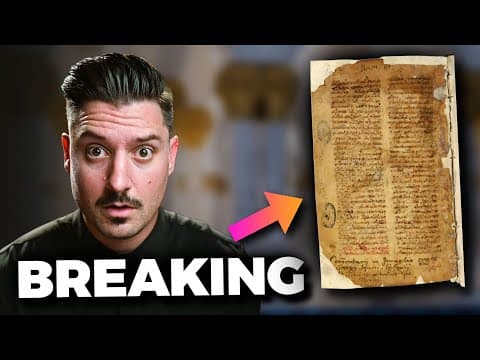
The only surviving copy of George's commentary is found in Vatican Syriak 154, a manuscript that has only recently been translated. This text, which had remained largely unnoticed for centuries, provides a crucial insight into early Christian apologetics against Islam. George's work is not merely a defense of scripture; it lays the groundwork for the Islamic dilemma as we understand it today.
In his commentary, George addresses the charge of corruption by posing four critical questions:
These questions are not only simple but also devastating to the doctrine of Tarif. George argues that if the gospel was corrupted before Muhammad, then Surah 10:94's instruction to consult the Jews and Christians makes no sense. Conversely, if the corruption occurred after Muhammad, it would be impossible for a universal council to have met to alter the texts, as the gospel was already widely disseminated in various languages.
George further questions the motive behind any supposed corruption. He argues that Christians would have no reason to alter their scriptures, as the gospel promotes poverty and spiritual integrity. He contrasts this with Islam, suggesting that material gain was a motive for attracting followers.
In addressing the who question, George points to the Quran's own acknowledgment of the apostles as divinely chosen and faithful. If they were indeed faithful, how could they have transmitted corrupted accounts? This rhetorical strategy effectively uses Islamic scripture to bolster the reliability of the gospel.
After dismantling the corruption charge, George constructs a positive argument for the reliability of the gospel. He outlines five criteria that affirm its truth:
These criteria provide a rational framework for understanding why Christianity is true, showcasing George's profound insight into the nature of divine revelation.
George of Beltan's arguments reveal that the doctrine of Tarif was a reaction to the contradictions between the Quran and the Bible. His work demonstrates that early Christians were not only aware of these contradictions but were actively engaging with them. This historical context challenges the notion that the Islamic dilemma is a modern invention.
Some may argue that George was merely addressing the issue of corruption without articulating the Islamic dilemma. However, his conclusions about the reliability of the gospels inherently lead to the dilemma's implications. If the gospels are true, then the Quran, which contradicts them, cannot stand.
Additionally, objections claiming that the previous scriptures referenced in Surah 10:94 only pertain to the stories of the prophets fail to recognize that these stories also contradict the Quran. The idea that corruption solves the problem is dismantled by George's arguments, which highlight the logical inconsistencies in such claims.
George of Beltan's work in the 8th century provides a foundational understanding of the Islamic dilemma. His insightful questions and robust defense of the gospel's reliability not only counter the claims of corruption but also affirm the truth of Christianity. This historical perspective enriches our understanding of early Christian apologetics and underscores the enduring relevance of George's arguments today.
As we engage with these discussions, let us remember the importance of George's four questions: when, who, why, and what. These inquiries remain vital tools for addressing the challenges posed by Islamic claims against the Christian faith. The Islamic dilemma is not a modern invention; it is a historical reality that has been recognized and articulated by Christians for over a millennium.



















