Personal finance mistakes can significantly impact your financial future. Key errors include not earning enough, insufficient saving, lack of clear financial goals, overspending on non-essential items, avoiding investment risks, ignoring tax and estate planning, marrying a financially incompatible partner, and neglecting insurance for catastrophic risks. Addressing these areas thoughtfully can lead to greater financial well-being and security.
Personal finance is a critical aspect of life that affects our ability to live comfortably and securely. However, many people make common mistakes that can hinder their financial progress. Ben Felix, Chief Investment Officer at PWL Capital, highlights the top 10 biggest mistakes in personal finance and offers insights on how to avoid them.
One of the most overlooked yet significant mistakes is not earning enough income. While factors like luck, family background, and country of birth influence income, your human capital—your ability to earn through work or entrepreneurship—is your most valuable asset.
Investing in your human capital through formal education or learning a trade can increase your lifetime earnings and make your income more resilient during economic downturns. Fields such as engineering, healthcare, and business have historically offered higher economic rewards. Advanced certifications, like the CFA charter in finance, can further boost income.
Although education does not guarantee higher income, it improves the range of income levels you can expect. Income and education also correlate with happiness, lifespan, and health span. However, choosing a career solely for income without personal satisfaction is not advisable. Ultimately, no amount of frugality can fully compensate for low income.
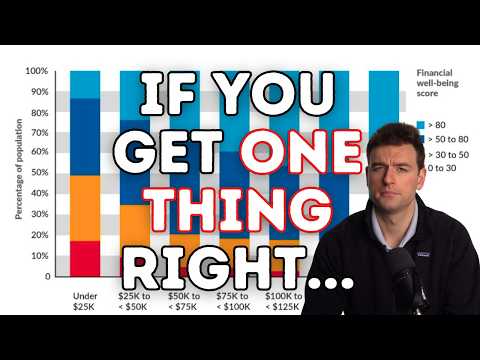
Once your income exceeds your basic living expenses, saving becomes essential for future needs like retirement. Saving money is strongly linked to financial well-being across all income levels.
While there is no perfect savings rate, a common guideline is to save about 10% of your income, in addition to government pension contributions. Research shows that saving 10% from age 25 to 65 in a diversified stock portfolio can result in retirement income exceeding working income.
If you start saving later or want to retire earlier, you will need to save a higher percentage. For example, to retire after 40 years of work and maintain 70% of your income in retirement, you might need to save at least 11.28% of your income. Adjustments are necessary based on your investment portfolio and retirement goals.
Using financial planning tools or consulting a financial planner can help you determine the right savings rate based on your goals and priorities.
Without clear financial goals, people often make erratic financial decisions. Many struggle to articulate their goals or settle for superficial ones like "I want to retire."
Using frameworks like the PERMA-V model—which includes positive emotion, engagement, relationships, meaning, accomplishment, and vitality—can help uncover deeper, value-driven goals. A study involving 310 people showed that when prompted with these categories, individuals identified more meaningful goals aligned with their values.
Understanding your true financial goals is crucial because the path to achieving them may differ significantly from pursuing surface-level objectives or making impulsive decisions.
Spending money often provides temporary happiness, especially when acquiring new material possessions. However, people quickly adapt to these feelings, and the long-term happiness gained from things like a fancier house or luxury items is limited.
People tend to overestimate how much material purchases will improve their happiness. For example, owning a cottage or boat might seem idyllic, but the reality includes maintenance, unexpected problems, and stressful situations.
How you spend your time influences your happiness more than what you own. Those who value time over money tend to be happier, have stronger social connections, and better relationships.
Spending less today on non-essential items can give you more control over your time in the future, allowing you to choose how and where you work. Always consider what you aim to accomplish with your spending and whether there are more efficient ways to achieve those goals.
Taking the right amount of risk in investing is essential for higher expected returns. Owning stocks in a diversified portfolio generally leads to better long-term outcomes than bonds or cash.
Risk is often misunderstood as volatility, which can be unsettling. However, for long-term investors who do not need immediate access to funds, volatility is less relevant than the risk of permanent loss.
Investing in a broad market index fund reduces the risk of total loss. Avoiding stocks altogether means missing out on higher returns, which can require saving significantly more to reach the same retirement goals.
For example, to match the retirement outcome of someone saving 10% of income in a 100% global stock portfolio, an investor in a 60% stock and 40% bond portfolio would need to save 19% of their income, and someone holding only government bills would need to save 57%.
While taking investment risk is necessary, taking the wrong kinds of risk is a major mistake. Speculating on individual stocks, cryptocurrencies, or using options often resembles gambling rather than investing.
Gambling has a negative expected return and relies on luck, while investing has a positive expected return with some volatility. Over time, investing tends to yield positive results, whereas gambling leads to losses.
Avoid distractions from financial product advertisements and news headlines that encourage negative expected return bets. Stick to a low-cost, diversified portfolio.
Tax planning is a rare free lunch in personal finance. While paying your fair share of taxes is necessary, many government-approved strategies can reduce your tax burden.
Examples include:
Even simple decisions, like choosing the right tax year for RRSP deductions, can have significant impacts.
Estate planning is often neglected but is crucial for tax efficiency, liquidity, and ensuring your assets are distributed according to your wishes.
Without a will or proper estate plan, your estate will be distributed according to prescribed rules that may not align with your preferences. Proper planning also reduces stress for your loved ones during difficult times.
Financial compatibility is important in marriage. There are two broad spending profiles: tightwads (those who dislike spending) and spendthrifts (those who enjoy spending).
Interestingly, tightwads and spendthrifts are more likely to marry each other, but this mismatch often leads to financial disagreements, which are a strong predictor of divorce.
Since spending habits are stable over time, it is important to consider financial compatibility seriously before committing.
Insurance typically has a negative expected return but is essential for protecting against catastrophic financial risks.
Life insurance is critical if you have financial dependents to replace future earnings in case of untimely death. Disability insurance protects your future earnings if you become unable to work.
Although unpleasant to consider, failing to plan for death or disability can be financially devastating.
Personal finance mistakes can have profound effects on your financial security and well-being. By focusing on increasing your income, saving adequately, setting meaningful goals, spending wisely, taking appropriate investment risks, utilizing tax and estate planning, ensuring financial compatibility in relationships, and protecting against catastrophic risks, you can build a solid foundation for a comfortable financial future.
Engaging with a qualified financial planner can help you navigate these areas effectively and avoid costly mistakes.