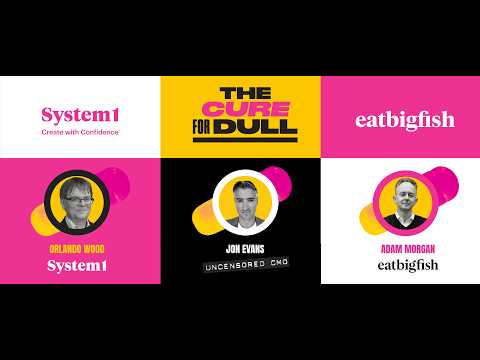
This article explores the pervasive issue of dull marketing communications, its significant commercial cost, and how emotional measurement can help identify and combat dullness in advertising. Insights from experts Adam Morgan and Orlando Wood highlight the importance of creativity and emotional engagement to enhance marketing effectiveness and reduce wasted expenditure.
In the world of marketing, dull and mediocre communications remain a persistent problem despite the best efforts of many professionals. This article delves into a recent webinar titled "The Cure for Dull," featuring marketing experts Adam Morgan, Orlando Wood, and John, who discuss the origins of this initiative, the cost of dullness in advertising, and how to measure and ultimately defeat dull marketing.
Adam Morgan, known as the original challenger brand expert and author of the book on Challenger Brands, has spent 27 years researching and working with challenger brands. Despite his passion, he became increasingly dispirited by the sheer volume of dull marketing communications still prevalent in the industry.
Adam reflects on his 40 years in marketing and notes that while many professionals strive to create impactful work, a vast amount of marketing remains uninspiring. This realization sparked a desire to address the issue head-on.
To find ways to make dull subjects more interesting, Adam looked beyond marketing to fields where making content engaging is critical, such as physics teachers trying to inspire disinterested students and reality TV producers. This exploration led to the creation of a podcast called "Let's Make This More Interesting," now in its third season.
Adam collaborated with Peter Field, a long-time colleague and expert in marketing effectiveness, to analyze the cost of dull advertising using the IPA database, one of the most robust sources of marketing data globally. They developed proxies for dull and interesting advertising and discovered that while dull advertising can be commercially effective, it requires an average of 10 million pounds more in media spend per campaign to achieve the same results as interesting advertising.
This finding was a pivotal moment, highlighting the tangible financial impact of dull marketing.
John, the webinar host and Chief Customer Officer at System 1, joined forces with Adam to broaden the initiative. System 1, known for its methodology and thought leadership in measuring emotional responses to advertising, brought valuable data and insights to the project.
Together, they presented their findings at the Cannes Lions International Festival of Creativity, aiming to raise awareness of the cost of dull marketing on an international scale. Although initial data focused on the UK and US markets, efforts are underway to expand this research globally.
A critical step in defeating dull marketing is understanding how to measure it. System 1 uses a framework based on Paul Ekman's seven core human emotions, which are universal across cultures and ages. They added an eighth category: "nothing at all," representing the absence of emotional response.
Advertising aims to evoke feelings that influence consumer behavior. According to research, the more people feel, the more likely they are to buy. This aligns with the concept from Daniel Kahneman's "Thinking, Fast and Slow," where the brain's System 1 (emotional, fast thinking) drives most decisions, while System 2 (rational, slow thinking) justifies them afterward.
Therefore, if an advertisement leaves the audience feeling nothing, it fails to engage the critical System 1 decision-making process, reducing its effectiveness.
Orlando Wood, a key figure at System 1 and author of books such as "Lemon" and "Look Out," has contributed significantly to developing this measurement methodology. By analyzing emotional responses to thousands of advertisements over time, System 1 can identify which ads are dull and which resonate emotionally with audiences.
The research presented shows that dull marketing is not just a creative failure but a costly business problem. Brands that produce dull advertising must compensate by spending significantly more on media to achieve comparable commercial outcomes.
This insight challenges marketers to rethink their strategies and prioritize creativity and emotional engagement to maximize return on investment.
The Cure for Dull initiative highlights a crucial issue in marketing: the prevalence and cost of uninspiring advertising. By leveraging emotional measurement tools and embracing creativity, brands can reduce wasted spend and connect more effectively with consumers.
The collaboration between experts like Adam Morgan, Orlando Wood, and John demonstrates the power of combining research, data, and practical insights to tackle this challenge.
Marketers are encouraged to diagnose dullness in their campaigns and strive for advertising that not only informs but also emotionally engages, ensuring their messages stand out in a crowded marketplace.
To defeat dull marketing, professionals must:
By doing so, the marketing industry can move towards more effective, engaging, and commercially successful advertising.