
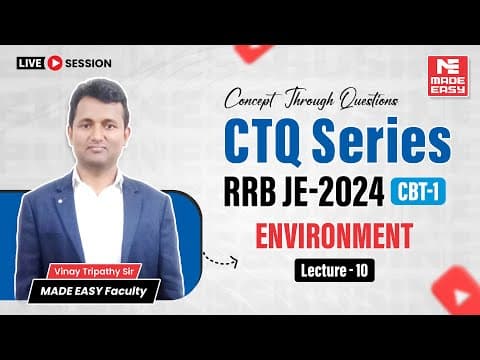
This blog post summarizes key concepts from the CTQs Series Lecture on Environment, covering greenhouse gases, ozone layer, deforestation, climate change, and sustainable practices, providing a clear understanding of environmental issues and their implications.
In this lecture, Banay Tripathi, an experienced educator with over 15 years of teaching, delves into the critical aspects of environment and ecology. The focus is on understanding concepts through questions, aiming to enhance logical and scientific thinking among students preparing for competitive exams.
Greenhouse gases (GHGs) are crucial in understanding climate change. The primary GHGs include:
Among these, Oxygen (O2) is not a primary greenhouse gas, as it does not contribute to the greenhouse effect.
GHGs can be categorized into two types:
The ozone layer is found in the stratosphere, approximately 25 to 35 kilometers above the Earth's surface. It forms due to the interaction of ultraviolet (UV) rays with oxygen molecules, creating ozone (O3). This layer is essential for protecting life on Earth from harmful UV radiation.
Ozone depletion occurs due to human activities that release chlorofluorocarbons (CFCs) and other ozone-depleting substances. The consequences of ozone depletion include increased UV radiation reaching the Earth's surface, leading to health issues such as skin cancer and cataracts.
Deforestation is primarily driven by agriculture, urbanization, and logging. It leads to:
One notable practice contributing to deforestation is shifting cultivation, also known as slash-and-burn agriculture, which exhausts soil fertility over time.
Climate change is significantly influenced by:
The Paris Agreement, established during COP 21 in 2015, aims to address climate change by limiting global warming to well below 2 degrees Celsius.
The effects of climate change include:
Sustainability refers to meeting the needs of the present without compromising the ability of future generations to meet their own needs. This includes:
Biodiversity is vital for ecosystem services, which include:
Understanding these environmental concepts is crucial for addressing the challenges posed by climate change and promoting sustainable practices. The CTQs series provides a structured approach to learning, emphasizing the importance of conceptual clarity through questioning. By grasping these concepts, students can better prepare for competitive exams and contribute positively to environmental conservation efforts.



















