
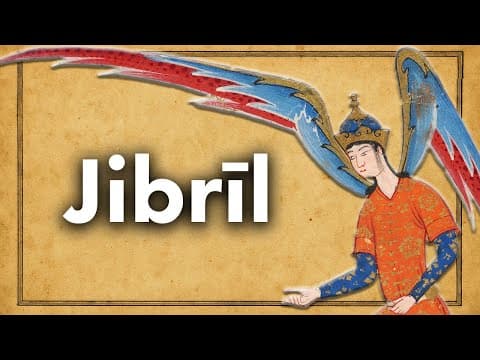
Gabriel, known as Jibrīl in Arabic, is a pivotal figure in Islam, serving as the messenger of God to the prophets, particularly Muhammad. This blog explores Gabriel's roles, significance, and the theological debates surrounding angels in Islam, highlighting his influence on Islamic practices and beliefs.
In one of the most famous hadith, the Prophet Muhammad is approached by a stranger who kneels before him and asks about Islam, faith, good deeds, and the nature of the end times. After Muhammad answers all of his questions, the stranger responds, "You have told the truth." This surprises Muhammad's companions, who wonder about the identity of this man who seems to possess equal or superior knowledge. Once the stranger leaves, Muhammad reveals to his companions, "That was Gabriel. He came to you in order to teach you of your religion."
Gabriel, or Jibrīl in Arabic, is a key figure in Islam, recognized as one of the greatest angels, a companion and guardian of the prophets, and the foremost agent of God on earth. His role is significant not only in Islam but also in Judaism and Christianity, providing a fascinating lens through which to understand how Islam integrates, adapts, and distinguishes itself from other Abrahamic religions.
To understand Gabriel's role, we must first explore the concept of angels in Islam. Like in Judaism and Christianity, angels are seen as God's messengers and agents. They convey revelations, execute divine commands, and sometimes engage in battles on God's behalf. Angels exist invisibly in a spiritual realm alongside our own, capable of interacting with humans and entering and exiting heaven. They also play a crucial role in recording humanity's actions; the Quran states that every human has two angels watching over them, recording their good and evil deeds.
Belief in angels is a fundamental expectation for all Muslims, as important as belief in scripture, prophets, resurrection, and God. Since the early days of Islam, theologians have debated whether angels are infallible and whether they possess free will. For instance, the Prophet's cousin, Ibn Abbas, argued that angels could act contrary to God's commands, while early mystic Hassan al-Basri asserted they could not. This debate ties into the larger question of whether Iblis (Satan) is a fallen angel or a jinn.
In Islam, Gabriel is one of the four top angels, alongside Michael (Mikail), Azrael (the angel of death), and Israfil (the angel who will blow the trumpet on the Day of Resurrection). While Gabriel is primarily known as God's messenger to humanity, Michael serves as God's messenger to the other angels. Azrael guides the spirits of the deceased, and Israfil is tasked with signaling the end of the world.
Unlike Christianity, where Gabriel and others are often referred to as archangels, Islamic tradition does not formalize a taxonomy of angels in the same way. Gabriel is simply referred to as an angel, without the title of archangel.
Gabriel's most notable role in Islam is as the heavenly emissary who taught Muhammad that he was a prophet and conveyed the entire Quran to him. The Quran is viewed as God's final revelation to humanity, distinct from other scriptures that are seen as directed at specific peoples and times. The Quran, meaning "the recitation," is understood to be the literal speech of God, recited to Gabriel and then to Muhammad.
Muhammad's prophethood began when Gabriel appeared to him in a cave, commanding him to recite the words of God. This moment is preserved in the opening of Surah 96:
"Recite in the name of your Lord who created, created man from a clot. Recite, and your Lord is the most generous, who taught by the pen, taught man that which he knew not."
Over the next 22 years, Gabriel would regularly appear to Muhammad, delivering more revelations until the Quran was fully revealed. Beyond being a messenger, Gabriel is remembered as a companion, teacher, and guardian. He taught Muhammad how to pray and perform wudoo (ritual washing) and is seen as a friend who encouraged and corrected the Prophet when necessary.
Gabriel is also said to have fought alongside Muhammad in battles, such as Badr and Uhud, and accompanied him on the miraculous night journey to heaven from Jerusalem. His appearances varied; sometimes he was subtle, appearing in dreams, while at other times, he took on a human form or a more supernatural appearance, described as a gigantic being with 600 wings.
Aisha, Muhammad's wife, reported that the physical weight of divine communication could be taxing, noting that sweat dripped from Muhammad's forehead during revelations, even in cold weather. This illustrates the profound impact Gabriel's presence had on the Prophet.
Islamic tradition holds that Muhammad was not the only prophet guided by Gabriel. Scholars like Al-Tabari and Fakhr al-Din al-Razi describe Gabriel as the angel who delivered God's messages to all prophets throughout history. The Quran refers to Gabriel as the faithful spirit or the Holy Spirit, serving as an intermediary between God and humanity.
Gabriel's role extends beyond mere communication; he is depicted as a guardian angel. For instance, he is said to have saved Abraham from a blazing furnace and provided water for Ishmael and Hagar in the desert. He also protected Jesus from Satan and, in a controversial hadith, prevented Pharaoh from beseeching God for mercy as he was dying.
Gabriel's presence in Islamic tradition illustrates how Islam inherited and adapted beliefs from earlier Abrahamic faiths. His connection to Muhammad helped position Islam as the rightful heir to the Jewish tradition, encouraging Arabian Jews to embrace the new faith. The earliest biography of Muhammad describes how his wife Khadijah accepted his prophethood after her Christian cousin confirmed that he had been visited by the same spirit that guided Moses.
The relationship between Gabriel and Muhammad also led to significant theological implications. When a group of Arabian Jews questioned Muhammad about the angel who brought him revelation, they expressed a preference for Michael, viewing Gabriel with suspicion. This exchange prompted the revelation of Surah 2:97-98, emphasizing Gabriel's role in delivering the Quran and affirming the connection between the three Abrahamic faiths.
Gabriel's influence extends into everyday Muslim life, with various communities developing their own stories and traditions about him. One common rukas (incantation) against evil is said to have been taught to the Prophet by Gabriel. In some Shiite traditions, Gabriel is believed to have delivered special knowledge to Muhammad meant for his descendants, although this claim is not universally accepted.
Among Sufi mystics and philosophers, Gabriel represents the active intellect, bridging the human mind with higher truths. He is seen as a manifestation of inspiration, symbolizing the moment when the heart and mind accept new knowledge.
The angel Gabriel is a multifaceted figure in Islam, serving as a messenger, teacher, warrior, and companion. His role as the intermediary between God and humanity, along with his protective nature, makes him a central figure in Islamic tradition. Gabriel embodies the complexities of divine communication and the relationship between the known and the unknowable in Islam, illustrating the profound impact of this angel on the faith and its followers.



















