
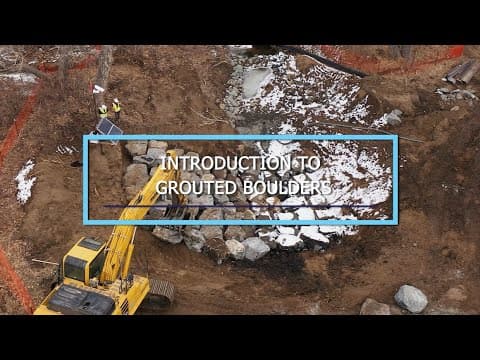
Grouted boulders are essential for stormwater management and stream stabilization, particularly in urban areas. This guide covers their installation, common issues, design considerations, and the importance of proper materials and techniques to ensure structural integrity and aesthetic appeal.
Grouted boulders are a construction technique that involves placing large quarried boulders closely together and filling the voids with concrete grout. This method is increasingly popular in the Colorado Front Range for stormwater improvements and stream stabilization due to its natural design aesthetics and proven effectiveness.
Grouted boulders consist of large boulders that are tightly packed and secured with a grout mixture. They are primarily used in urban waterways to enhance stormwater management and stabilize streams. Their design not only serves functional purposes but also blends well with natural landscapes.
Grouted boulders are commonly used in various applications, including:
The success of grouted boulder installations relies heavily on proper engineering design. Key factors include:
Before placing boulders, the subgrade must be prepared adequately. This involves:
Boulders should meet specific size criteria and durability requirements. The District specifies five standard sizes ranging from 24 to 48 inches. When placing boulders:
The grout used for filling the voids is similar to structural concrete but uses finer aggregates for better flowability. Key steps include:
Grouted boulder structures often require seepage control measures, such as steel sheet piles, to prevent water from undermining the structure. Proper connections between grouted boulders and seepage cutoff walls are essential to avoid piping conditions that can lead to structural failure.
To achieve an aesthetically pleasing finish, it is crucial to minimize grout visibility. This can be done by:
Grouted boulders are a versatile and effective solution for managing stormwater and stabilizing streams in urban environments. Proper installation techniques, material selection, and adherence to engineering guidelines are vital for ensuring the structural integrity and aesthetic appeal of these installations. For further information, resources such as construction guidance checklists and specifications can be found on the District's website.



















