
This blog post explores the rise of human civilization through the lens of ecological compatibility, examining the concept of ultrasociality, the reliance on energy resources, and the environmental consequences of our modern lifestyle. It discusses how our civilization's structure and energy consumption patterns have led to ecological overshoot and the potential implications for the future.
Human civilization has often been portrayed as a story of progress and greatness, culminating in our modern, high-tech, globalized society. However, this perspective overlooks a critical aspect: our civilization's compatibility with the planet and its ecological limits. This blog post introduces the concept of ultrasociality and examines how our societal structure has evolved, the energy resources we depend on, and the environmental consequences of our actions.
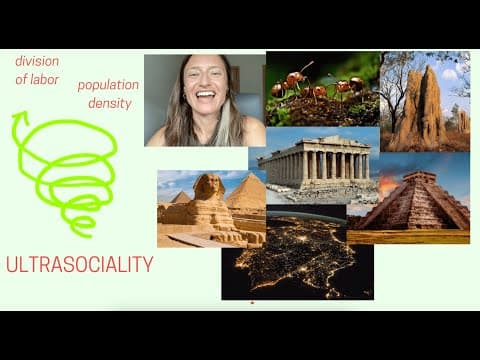
Ultrasociality refers to the way certain species, including humans, organize themselves into complex societies. This phenomenon is characterized by:
While many species use tools, humans uniquely harness material resources to augment our natural abilities and modify our environments. This transformation began around 12,000 years ago when the climate stabilized, allowing for the advent of agriculture and a reliable food supply, which in turn led to population growth and increased societal complexity.
Energy is the backbone of modern civilization. We utilize two main categories of material resources:
The reliance on fossil fuels has allowed us to support a growing population, currently estimated at eight billion. Synthetic fertilizers, for instance, have doubled agricultural yields, enabling us to sustain this large population.
Modern civilization resembles a space station on Earth, with farms and densely populated cities relying on a complex division of labor. This structure allows us to convert vast amounts of material and land into infrastructure and human-centric spaces. However, this system is heavily dependent on the planet's resources.
To understand the complexity of a civilization, one must consider net energy per capita. This metric reflects the energy available after accounting for the energy consumed in production. As civilizations grow, they require more energy to sustain their activities. The Cob-Douglas function in economics illustrates how labor and capital contribute to a society's output, but it fails to account for the crucial role of energy. As Stephen Keen suggests, without energy, labor is ineffective, and capital becomes obsolete.
The expansion of human civilization has led to significant ecological consequences. Over the past 2,000 years, we have eradicated approximately 45% of the planet's biomass. The anthropogenic mass, which includes materials like cement and metals, now equals or exceeds the total biomass of all living organisms not designed for human use.
Human civilization is currently in a state of ecological overshoot, meaning we are consuming resources faster than the planet can replenish them. This unsustainable model has led to:
As we continue to extract resources and expand our infrastructure, we face inevitable consequences. The Hirsh Report from 2005 warned of the abrupt and revolutionary implications of oil peaking, emphasizing the need for a plan to mitigate the impacts of declining energy availability. Without such a plan, the transition could be chaotic.
Fossil fuels act as energy slaves, providing the equivalent work of hundreds of billions of humans. As these energy slaves retire, the activities of the real human workforce will be severely impacted. The reliance on fossil fuels for food transportation and agricultural production raises concerns about food security in urban areas.
The structure and maintenance of our civilization, characterized by population density and division of labor, have led us into a state of ecological overshoot. The environmental impacts of our resource consumption and pollution generation are significant and unsustainable. As we move forward, it is crucial to recognize the limitations of our current model and consider the consequences of our actions on the planet's health and our future.



















