
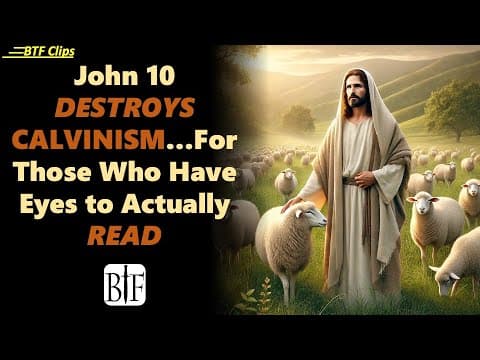
This blog post explores John 10 and its implications for Calvinism, arguing that the passage is often misinterpreted. It clarifies the distinction between sheep and goats, emphasizing that Jesus' sacrifice is for all sheep, not just a select few. The post critiques the Calvinist interpretation and highlights the importance of understanding the context of scripture, particularly regarding works and belief.
In the ongoing theological debate surrounding Calvinism, John 10:26 is frequently cited by Calvinists to support their views. This verse states, "But ye believe not because you are not of my sheep, as I said unto you." However, this interpretation may overlook the broader context and meaning of the passage. This blog post aims to dissect John 10, clarify its implications, and challenge the Calvinist perspective.
Calvinists often interpret John 10:26 as a definitive statement that those who do not believe are not part of Jesus' sheep. This interpretation stems from a skewed ideological lens that affects their understanding of scripture. The verse is not a pronouncement of judgment but rather an explanatory statement about belief and the nature of Jesus' followers.
To better understand this, consider the concept of a "line of Truth" that begins with God, progresses through Moses, and culminates in Jesus. If one is genuinely following God, they would also follow Moses and, subsequently, Jesus. However, many diverge from this path, leading to false beliefs. This divergence can stem from various influences, such as adherence to traditions that contradict scripture or political expediency.
In John 10:15, Jesus states, "As the Father knoweth me, even so know I the Father: and I lay down my life for the sheep." Calvinists interpret this to mean that Jesus died exclusively for a select group of believers, referred to as "my sheep." However, this interpretation neglects the broader context of Jesus' ministry and the nature of his sacrifice.
It is crucial to note that the term "goats" is not mentioned in John 10 or anywhere in the Book of John. Instead, Jesus refers to those who are lost as sheep without a shepherd. This distinction is significant because it indicates that Jesus' sacrifice encompasses all sheep, including those who may not yet recognize him as their shepherd.
Calvinists may attempt to use the sheep and goats analogy found in Matthew 25:32-33 to support their views. In this passage, Jesus separates the nations as a shepherd separates sheep from goats. However, the criteria for this separation are based on works, not faith alone.
In Matthew 25, the righteous are identified by their actions: feeding the hungry, giving drink to the thirsty, and caring for the sick. This emphasis on works challenges the Calvinist notion of predestination and salvation by faith alone. If works are the criteria for distinguishing between sheep and goats, then the argument for a select group of saved individuals becomes problematic.
John 10 emphasizes the relationship between the shepherd and his sheep. Jesus states that his sheep hear his voice and follow him. This relationship is not exclusive to a predetermined group but is open to anyone who chooses to listen and respond.
Jesus' declaration that "if any man enters in, he shall be saved" (John 10:9) reinforces the idea that salvation is available to all who respond to his call. The invitation is universal, and the distinction lies not in a select few but in those who choose to follow the shepherd's voice.
In conclusion, John 10 offers a profound insight into the nature of belief, the role of works, and the inclusivity of Jesus' sacrifice. The Calvinist interpretation of this passage often misses the broader context and the invitation extended to all. By understanding the nuances of scripture and the relationship between the shepherd and his sheep, we can appreciate the depth of Jesus' message and the call to follow him.
This examination of John 10 serves as a reminder to approach scripture with an open mind and a willingness to engage with its complexities, rather than adhering strictly to preconceived theological frameworks.



















