
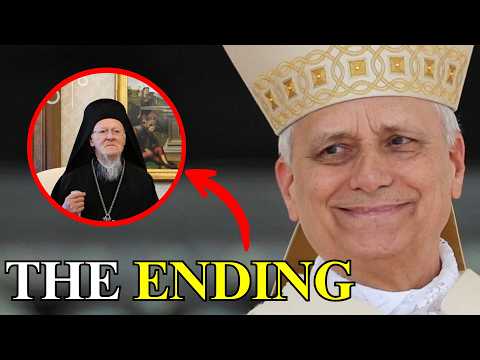
This blog post explores the Catholic dogma of papal supremacy, its implications for Orthodox theology, and how it shapes the understanding of authority and truth within the Church. It discusses scriptural foundations, historical context, and the necessity of a visible authority in resolving doctrinal disputes, emphasizing the role of the Pope in maintaining unity and clarity in faith.
The one Catholic dogma that shatters the entire structure of Orthodox theology isn't the filioque, the immaculate conception, or even divine simplicity. While these are significant differences, they stem from a deeper rupture: papal supremacy. This dogma touches the very foundation of how the Church functions, how truth is defined, and who has the authority to proclaim it.
The unresolved East-West schism, which has persisted for nearly a thousand years, can be traced back to this fundamental disagreement. If the Pope is indeed the vicar of Christ on earth, possessing universal jurisdiction and infallibility in teaching faith and morals, then the entire structure of Orthodox ecclesiology collapses. This raises critical questions about authority and unity within the Orthodox Church.
Have you ever wondered why the Orthodox Church hasn't convened a universally accepted ecumenical council since 787? Or why one patriarch can contradict another on essential doctrines such as divorce, contraception, and baptism? This isn't merely disunity; it's a vacuum of authority. The Orthodox ideal of conciliarity, which promotes shared governance by bishops, is noble in theory but has failed to resolve major theological and pastoral disputes for centuries.
The idea of one man having universal authority over the Church can feel jarring, especially in a world that values democracy and shared leadership. Many from an Eastern Orthodox background might argue that the Pope is merely a man and fallible, asserting that Christ is the only head of the Church. While this perspective sounds pious and biblical, it raises significant questions:
In the Orthodox Church today, there is no single magisterium to define doctrine. Different synods may permit remarriage, recognize Catholic baptisms, or allow contraception, leading to real confusion affecting real souls.
In contrast, the Catholic Church, through the authority of the successor of Peter, has preserved doctrinal unity and defined truths that deepen our understanding of Christ and salvation. The question isn't whether one man should have authority; it's whether Christ established that authority.
Let's examine the scriptural basis for this authority. In Matthew 16:18-19, Jesus tells Simon, "You are Peter, and on this rock I will build my church, and the gates of hell shall not prevail against it. I will give you the keys of the kingdom of heaven." The keys symbolize authority, as seen in Isaiah 22:22, where the royal steward governs in the king's name. Jesus gives Peter the keys, signifying a unique authority that is not shared with the other apostles.
In John 21:15-17, Jesus commands Peter to "feed my lambs" and "tend my sheep," emphasizing Peter's role in shepherding the Church. Early Church Fathers, such as St. Irenaeus and St. Cyprian of Carthage, recognized the preeminent authority of the Church of Rome. The Catechism of the Catholic Church states that the Pope, by virtue of his office as vicar of Christ, has full supreme and universal power over the whole Church (CCC 882).
Vatican I in 1870 defined papal infallibility under strict conditions, stating that the Pope speaks ex cathedra intending to define doctrine on faith or morals to be held by the whole Church (CCC 891). This doctrine is not an assertion of arrogance but a service to the Church, safeguarding the promise that the Spirit will guide it into all truth (John 16:13).
The papacy serves as a safeguard for unity and truth. Imagine a family with twelve children but no parents, each child interpreting the house rules differently. Chaos ensues without a visible final authority. The Pope is not above the Church; he is a servant within it, existing to preserve the faith rather than invent it.
Some may argue that Pope Honorius supported heresy. While he failed to condemn monothelitism, he never defined it ex cathedra. The Church condemned his personal failure, but this does not negate the infallibility of the office under strict conditions. Others claim that the early Church functioned without a Pope, which is a myth; the Bishop of Rome consistently acted as a final court of appeal in disputes.
Furthermore, the notion that papal supremacy violates Christ's humility is misguided. Christ's humility was rooted in obedience and service, and the Pope embodies this mission by shepherding the faithful.
Is papal supremacy an obstacle to unity with the Orthodox? On the contrary, it is the only path to true unity. Unity without truth is mere sentimentality. As Pope Benedict XVI stated, "The Church does not invent the truth; she serves it." The papacy is not the enemy of unity; it is its guardian.
The Catholic dogma of papal supremacy is not an optional belief; it is essential to the Church's identity, structure, and mission. This dogma does not oppress the faithful; it protects them from confusion, error, and fragmentation. It is rooted in scripture, affirmed by the Fathers, and developed through the centuries with the authority given by Christ himself.
If you are wrestling with these teachings, remember that God is not a God of confusion. He desires unity in truth and has not left us orphans.
What can you do today?
Above all, trust the words of Jesus: "You are Peter, and on this rock I will build my church." Let us build our lives on that same rock. May the Lord bless you and keep you, and may Mary, Mother of the Church, intercede for all of us. Stay rooted in truth and always move forward in love.



















