
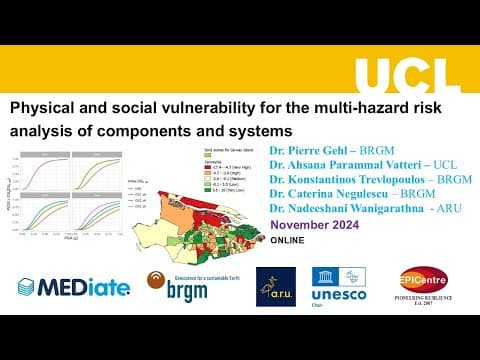
This blog post explores the critical aspects of physical and social vulnerability in the context of multi-hazard risk analysis, highlighting recent natural disasters' impacts on infrastructure and education, and discussing various modeling approaches for assessing vulnerability and resilience.
In recent years, the increasing frequency and intensity of natural disasters have underscored the importance of understanding both physical and social vulnerabilities in communities. This blog post delves into the insights shared during a recent webinar titled "Physical and Social Vulnerability for the Multi-Hazard Risk Analysis of Components and Systems." The discussion highlighted the devastating impacts of natural hazards, particularly on school infrastructure and education, and explored various methodologies for assessing vulnerability.
Recent events, such as the Dana storm in Valencia, have illustrated the long-term consequences of natural disasters on educational infrastructure. Reports indicate that approximately 11,000 students from 22 schools were unable to attend classes a month after the storm, with 92 schools completely destroyed. This situation is not unique to developing countries; similar incidents have occurred in the UK, where storms have disrupted education by damaging schools that had only recently reopened after previous flooding.
The webinar series, organized by the UNESCO Chair, aims to address various aspects of disaster risk reduction and resilience engineering. Upcoming topics include:
The discussion emphasized the need for robust vulnerability modeling that integrates multiple hazards and their interactions. Fragility models estimate the probability of reaching a specific damage state based on the intensity of a hazard. Various approaches to developing these models include:
Multi-hazard risk analysis involves understanding how different hazards interact and affect structural systems. The webinar introduced a classification of interactions:
Despite advancements in modeling, several challenges remain:
The webinar also addressed social vulnerability, defined as the susceptibility of individuals or communities to adverse impacts from natural hazards. Key dimensions of social vulnerability include:
To effectively assess social vulnerability, researchers utilize various methods:
Understanding both physical and social vulnerabilities is crucial for effective disaster risk management. The insights shared during the webinar emphasize the need for comprehensive modeling approaches that consider the complexities of multi-hazard interactions and the diverse impacts on communities. As climate change continues to exacerbate the frequency and severity of natural disasters, ongoing research and collaboration will be essential in building resilient infrastructures and communities.



















