
This blog post explores the projected ranges and objectives in index futures trading, detailing various scenarios such as two-session up and down closes, AM rallies, and PM reversals. It emphasizes the importance of understanding institutional order flow and price action to anticipate market movements effectively.
In this blog post, we will delve into the concepts of projected ranges and objectives in index futures trading, as discussed in the ICT mentorship program. This guide aims to simplify the complexities of index trading by breaking down the internal movements of indices and how they operate on a day-to-day basis.
Index trading can often appear complicated, but it can be simplified with the right understanding. Over the past 20 years, I have developed a framework for interpreting the daily range and price action of indices. This framework includes various scenarios that traders can expect to encounter, which will help in forecasting market movements.
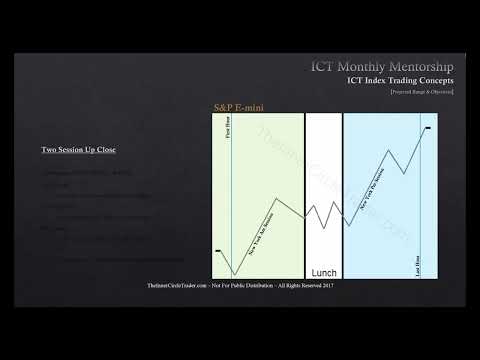
In a two-session up close scenario, the institutional order flow is typically bullish on both the daily and four-hour charts. The morning session usually sees a return to a discount array, followed by a price rally. During the lunch hour, the market may consolidate with shallow retracements, and the afternoon trend often runs the lunch hour lows to trigger sell stops before rallying into the close.
Conversely, in a two-session down close, the institutional order flow is bearish. The morning trend returns to a premium array and declines, with the lunch hour again consolidating with shallow retracements. The afternoon trend may run the lunch hour highs to trigger buy stops before declining into the close.
In this scenario, the institutional order flow is bullish, but the price is approaching a higher time frame premium PD array. The morning session starts off bullish until it hits this premium array, causing an intraday market reversal. The price may then return to a discount array, rally during lunch, and either run the lunch hour highs or reverse into the close.
Here, the institutional order flow is bearish, but the price has not yet traded down into a discount PD array on a higher time frame. The morning trend returns to a premium array and declines, with the lunch hour consolidating. The afternoon trend may run the lunch hour lows before reversing into the close.
In this scenario, the institutional order flow is neutral. The morning trend returns to a discount array, and the price rallies. The lunch hour sees consolidation, and the PM trend runs the lunchtime lows before reaching for the day's buy stops.
This is the opposite of the previous scenario, where the institutional order flow remains neutral. The morning trend returns to a premium array, and the price declines. The lunch hour consolidates, and the PM trend runs the lunchtime lows before reaching for the day's buy stops.
Understanding the criteria for projected ranges is crucial for anticipating market movements. For instance, if the daily and four-hour charts indicate a bearish trend, traders should focus on two-session down close scenarios. Conversely, if the charts are bullish, two-session up close scenarios should be prioritized.
To illustrate these concepts, I will share a real-time example from June 22, 2017, when I sold short at 2437, anticipating the price to trade down into a discount array. The projected range I used for this trade demonstrated how I formulated my ideas based on the market's behavior.
In conclusion, understanding projected ranges and objectives in index futures trading is essential for effective market analysis. By recognizing the various scenarios and the underlying institutional order flow, traders can better anticipate price movements and make informed trading decisions. The eight projected ranges discussed provide a framework for navigating the complexities of index trading, allowing traders to focus on liquidity and stop hunting in a trader's market.
Until the next lesson, I wish you good luck and successful trading!



















