
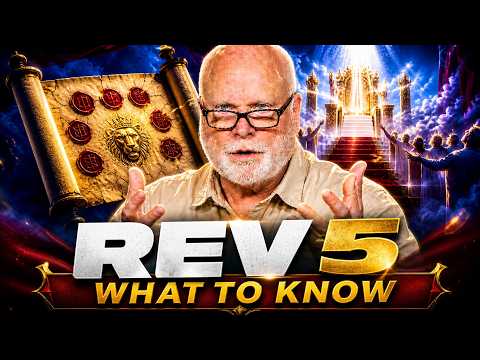
Revelation Chapter 5 reveals the significance of the scroll in God's right hand, which is the title deed to Earth. This chapter emphasizes the importance of Jesus as the kinsman redeemer who is worthy to open the seals and redeem creation from sin. It explores the themes of redemption, the struggle against sin, and the ultimate restoration of both humanity and the Earth.
Many readers often overlook Revelation Chapter 5, but doing so is a significant mistake. This chapter contains profound truths about redemption and the authority of Jesus Christ. The scroll that God holds in His right hand is not just any book; it is the title deed to Earth, making it one of the most important documents in the universe, second only to the Book of Life.
The Book of Life is crucial because it determines eternal destiny. Revelation 20:15 states, "And whosoever was not found written in the Book of Life was cast into the Lake of Fire." This emphasizes the necessity of having a relationship with Jesus Christ to avoid eternal separation from God.
In contrast, the scroll in Revelation 5:1 is the title deed to Earth. Understanding this scroll is essential for grasping the overall message of Revelation.
In Revelation 5:1, we read, "And I saw in the right hand of him that sat on the throne a book written within and on the backside, sealed with seven seals." This scroll represents God's authority over creation, which was initially given to Adam. In Genesis 1:26, God grants Adam dominion over the Earth. However, Adam's sin resulted in the forfeiture of this dominion, leading to humanity's bondage to sin.
Sin has dominion over humanity, as illustrated in Romans 7:14-24. Paul expresses the internal struggle between the desire to do good and the reality of sin's grip. This struggle is akin to addiction, where individuals often find themselves doing what they do not wish to do. The only solution to this bondage is redemption through Jesus Christ.
Redemption is a multi-faceted process involving three key aspects:
The concept of the kinsman redeemer is vital in understanding Jesus' role. According to Leviticus 25, a relative could redeem a person or property sold into slavery. Jesus, being fully God and fully man, qualifies as our kinsman redeemer. He paid the price for our sins, allowing Him to reclaim both humanity and the Earth.
The scroll in Revelation 5 is sealed with seven seals, indicating that it contains specific information about the events that will unfold during the tribulation. Each seal represents a significant event in the process of redemption. The opening of these seals signifies the beginning of the restoration of creation.
In Revelation 5:2-4, a strong angel proclaims, "Who is worthy to open the book and to loose the seals thereof?" No one in heaven or on Earth is found worthy, leading John to weep. This moment underscores the gravity of the situation: without someone worthy to open the scroll, the world remains in its sinful state.
However, in Revelation 5:5, one of the elders reassures John that the Lion of the tribe of Judah, the Root of David, has prevailed. This title emphasizes Jesus' authority and victory over sin and death, achieved through His sacrificial death on the cross.
When John turns to see the Lion, he instead sees a Lamb that appears slain (Revelation 5:6). This imagery highlights the paradox of Jesus' victory: He conquered not through brute strength but through humility and sacrifice. The Lamb symbolizes Jesus' role as the sacrificial offering for humanity's sins.
As Jesus takes the scroll, the four living creatures and the twenty-four elders fall down before Him, worshiping Him and singing a new song (Revelation 5:8-10). This new song acknowledges Jesus' worthiness and His redemptive work, emphasizing that He has made believers kings and priests who will reign on Earth.
Following the worship of the elders, countless angels join in praising Jesus (Revelation 5:11-12). The number of angels is described as myriads of myriads, indicating an innumerable multitude. All of creation, including every creature in heaven, on Earth, and under the Earth, joins in worship, acknowledging the authority and power of the Lamb (Revelation 5:13-14).
Revelation Chapter 5 is a pivotal moment in the narrative of redemption. It reveals the significance of the scroll as the title deed to Earth and emphasizes Jesus' role as the kinsman redeemer. Through His sacrifice, Jesus is worthy to open the seals and initiate the restoration of creation. This chapter sets the stage for the unfolding events of the tribulation and the ultimate redemption of both humanity and the Earth.



















