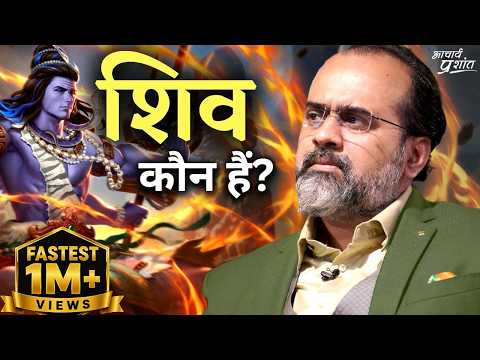
Acharya Prashant explores the essence of Shiva, emphasizing that Shiva is not a deity to be worshipped in a conventional sense but represents pure consciousness and the ultimate truth. He discusses misconceptions surrounding Shiva and the significance of Mahashivaratri, urging individuals to seek the true nature of Shiva within themselves rather than through external rituals.
In the context of Mahashivaratri, Acharya Prashant delves into the profound question of who Shiva truly is. He emphasizes that the understanding of Shiva transcends traditional worship and rituals, urging seekers to explore the deeper essence of Shiva as pure consciousness.
Acharya Prashant begins by discussing the symbolism of Shiva's third eye. When this eye opens, it signifies the dissolution of all illusions and misconceptions. The opening of the third eye represents a deeper understanding that goes beyond mere words or mantras. It is a call to transcend superficial beliefs and connect with the essence of existence.
Shiva is often misunderstood, and many misconceptions surround his identity. Acharya Prashant points out that the true nature of Shiva is not confined to the stories and myths that have been propagated over time. Instead, he urges individuals to look beyond these narratives and understand that Shiva represents the ultimate reality—the pure consciousness that exists beyond the physical realm.
Prashant addresses various questions and misconceptions about Shiva, such as:
He emphasizes that many of these beliefs are rooted in misunderstandings and that the essence of Shiva is often lost in the clutter of traditional narratives.
To clarify the true nature of Shiva, Acharya Prashant references the teachings of Acharya Shankar, who articulated profound insights about the self and the universe. Shankar's teachings encourage individuals to recognize that their true identity is not tied to their physical form or societal roles but is instead rooted in the realization of the self as Shiva.
Acharya Shankar's philosophy of non-duality is central to understanding Shiva. He teaches that the self is not separate from the universe; rather, it is an integral part of the cosmic whole. This realization leads to the understanding that all distinctions—between the self and the other, the sacred and the mundane—are ultimately illusory.
Mahashivaratri is not merely a festival of rituals and offerings; it is an opportunity for introspection and self-realization. Acharya Prashant encourages individuals to use this occasion to reflect on their own consciousness and to seek the truth of Shiva within themselves.
Prashant stresses that true devotion to Shiva involves purifying one's consciousness. He warns against the pitfalls of external rituals that do not lead to genuine understanding. Instead, he advocates for a deep inner exploration that reveals the true nature of Shiva as the essence of consciousness.
In conclusion, Acharya Prashant's insights on Shiva during Mahashivaratri challenge conventional beliefs and encourage a deeper understanding of the divine. Shiva is not a distant deity but the very essence of consciousness that resides within each individual. By recognizing this truth, one can celebrate Mahashivaratri not just as a festival but as a profound journey towards self-realization and liberation from the illusions of the material world.